
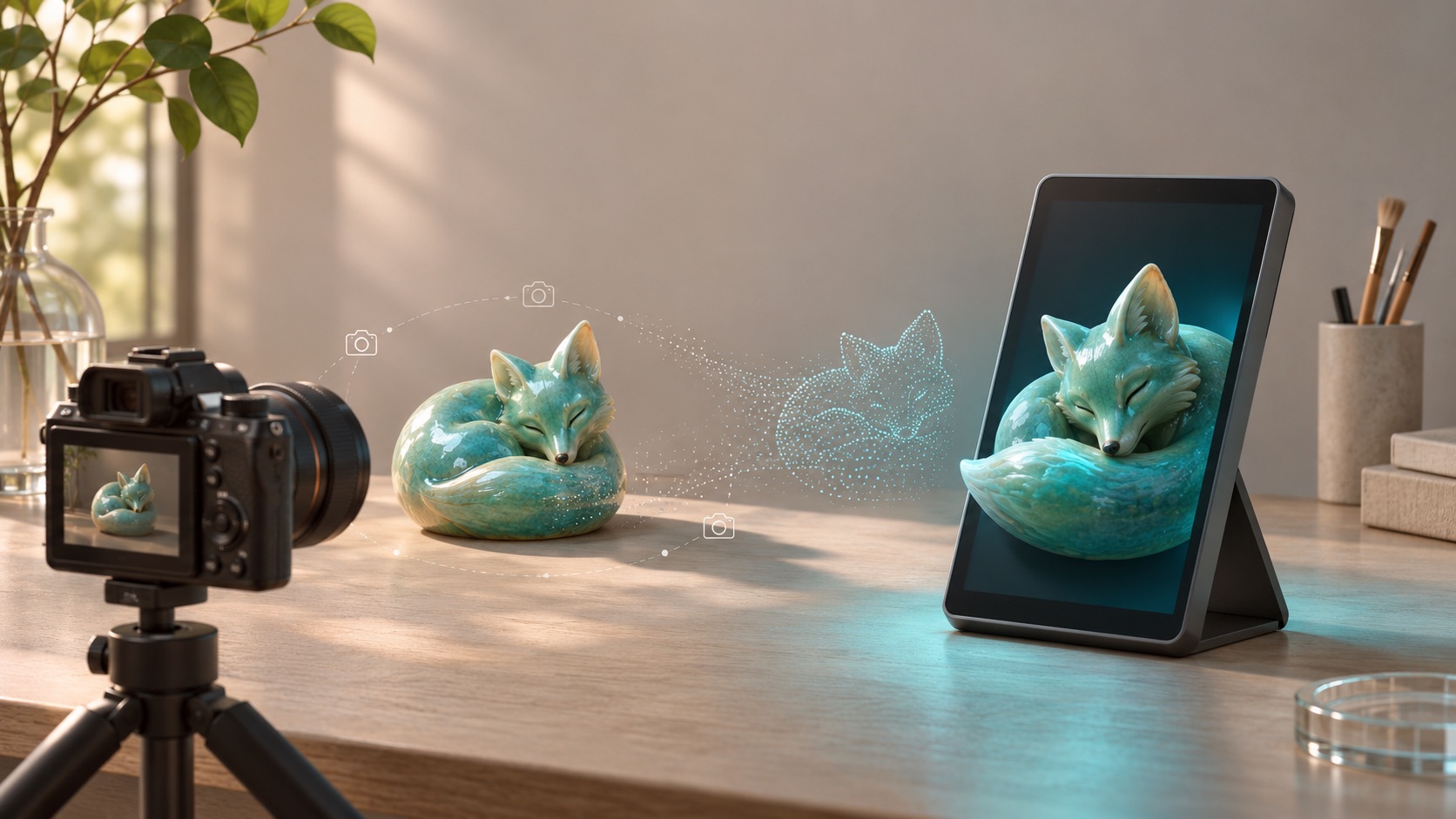
The six-inch ELF-MN1 brings Sony’s Spatial Reality Display technology to a smaller desktop format, while an XYN update expands the tools for turning real objects into digital assets.
Sony is developing both sides of its spatial-content ecosystem: the tools that create 3D objects and the displays that make them visible without a headset. Two announcements published on October 28 connect those efforts, combining a compact display for characters and objects with broader capture capabilities.
The potential is straightforward: create a digital version of something real, then view it with stereoscopic depth on a desk. Regional availability and application support will determine how accessible that workflow becomes.
A six-inch display for characters, avatars and objects
The ELF-MN1 announcement introduces a six-inch Spatial Reality Display that connects to compatible smartphones or Windows PCs. Sony explicitly includes objects generated with its XYN spatial capture solution among the content it can show.
This is glasses-free stereoscopic viewing with eye tracking. Sony’s specification sheet lists a 1080 × 2160 LCD panel, 470-nit brightness and third-generation eye-recognition sensing. That resolution describes the panel; it should not be read as a confirmed per-eye resolution.
The device is intended for a single viewer at 30–80 cm. Its small, portrait-oriented design lends itself to digital figures and objects viewed up close.
The same sheet lists Unity and OpenXR support, with no Unreal Engine support indicated for this model. That matters when considering how to bring existing content to the display.

Small hardware, specific compatibility requirements
A USB-C connection does not make every phone or computer compatible. The display requires DisplayPort Alt Mode, and Sony notes that the power adapter and charging cable are sold separately.
Sony’s recommended PC requirements include Windows 11, 16 GB of RAM, a six-core Core i5 or Ryzen 5, and a GeForce RTX 2070 Super or Radeon RX 5700 XT or better. Its tested phone list includes selected Xperia, Galaxy, Pixel and iPhone models.
Performance depends on the scene: Sony warns that complex content can cause substantial frame-rate drops even on a system meeting those recommendations.
The Japanese specification page schedules release for December 11, 2026. Sony’s international announcement restricts availability to Japan; no Spanish or European launch or euro price is confirmed.
The published material concentrates on supported applications and rendered objects. It does not establish direct SBS, MV-HEVC or Blu-ray 3D playback, or compatibility with conventional PC games.
XYN adds object capture to its spatial-content tools
Alongside the display, Sony announced an expansion of XYN Spatial Capture.
XYN Spatial Scan’s Venus algorithm now supports generating individual objects as well as backgrounds for virtual production. Creators can define the area to reconstruct, with Sony highlighting the reproduction of transparency and gloss.
Spatial Scan Navi gains an Object: Assist Mode that adapts capture guidance to the subject’s size for photographing it from around all sides. The Spatial Renderer Plugin also receives splat-editing, processing and flicker-suppression improvements for Unreal Engine workflows.
These are tools for reconstructing 3D assets. They do not constitute a new stereoscopic video format or a camera mode that records a left-eye and right-eye video pair.

More purchasing options, with regional limits
Sony’s updated XYN plans include Free, Creation 500, Creation 2000, Creation 2000 + Renderer and Custom options. Paid Creation plans combine application licences with tokens consumed when generating assets.
The Free plan includes no monthly tokens: users can purchase them separately. Creation 500 is listed at $20 per month before tax, with 500 tokens. Sony’s examples show that this allowance supports only a small number of lower-quality generations, rather than hundreds of finished objects.
The capture announcement names the United States, excluding its territories, and Canada as the available markets. A European rollout is not confirmed.
A closer connection between creating and viewing 3D
Taken together, these announcements offer a more tangible direction for Sony’s XYN ecosystem. A scanned object could become something to inspect and enjoy with depth, rather than remaining an asset viewed on a conventional 2d screen.
The connection is supported by Sony’s own description of the ELF-MN1, but it should not be mistaken for a universal, one-click workflow. Capture quality, asset preparation and compatible display applications still matter.