
From XREAL AURA and new Android XR games to Vision Pro improvements and live immersive cameras, spatial computing is expanding how we watch, play and create in 3D. Meanwhile, Steam Frame highlights an opportunity that remains unfinished: bringing stereoscopic depth to conventional games.
Spatial computing is advancing across several fronts. New devices are making immersive experiences more portable, software updates are improving everyday use, and media players are opening up existing 3D libraries. Behind the scenes, production tools are also creating new possibilities for live stereoscopic entertainment.
This roundup brings together recent launches and significant developments from throughout 2026, looking at what they offer today, what still needs verification, and where stereoscopic 3D could make the biggest difference.
XREAL AURA brings Android XR to transparent glasses
Google and XREAL announced AURA’s launch on October 28, opening orders in the United States, Canada and South Korea, followed by Japan on November 2. Shipments are expected to begin in mid-November, with launch pricing starting at $1,099 through the end of the year. Spain and the rest of Europe are absent from that confirmed initial rollout.
AURA uses optical see-through lenses, so users see their surroundings directly. Its official specifications include Sony micro-OLED displays with 1920 × 1200 pixels per eye, a 70-degree field of view and refresh rates up to 120 Hz, alongside 6DoF tracking and electrochromic dimming.
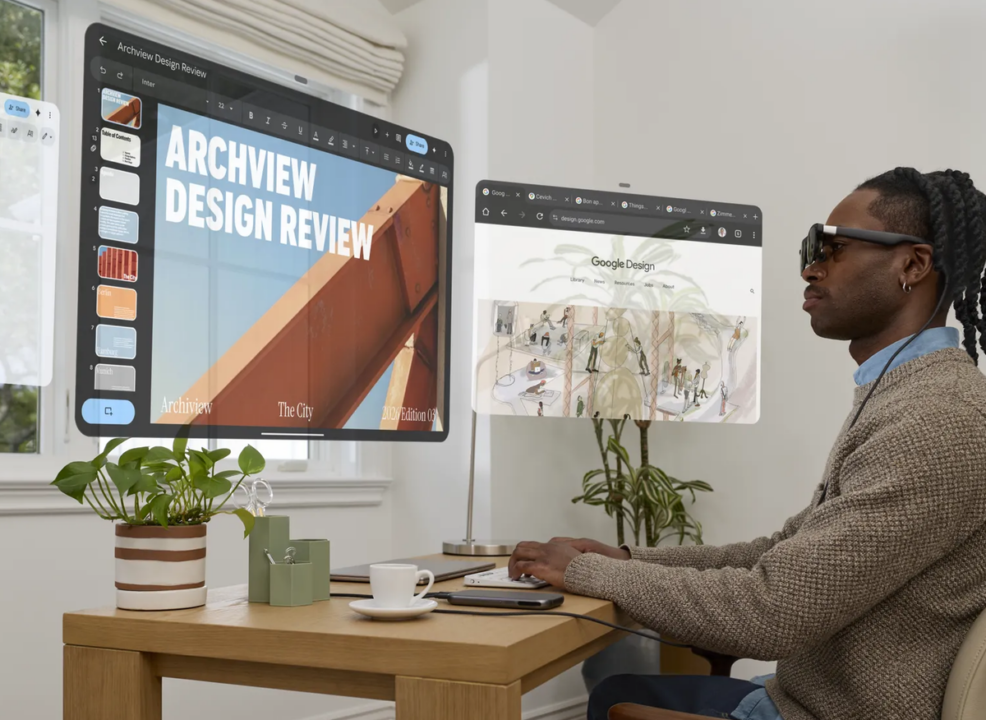
The glasses weigh 95 grams. A separate computing puck adds another 265 grams and houses the processing hardware, battery and touchpad. This moves weight away from the face, although the cable and puck remain part of the experience.
AURA runs Android XR applications, supports hand and voice input, and works with Bluetooth keyboards, mice and controllers. Its USB-C DisplayPort input also brings an external device’s display into the spatial workspace.
Automatic 2d-to-3D conversion is part of the platform
Google introduced auto-spatialization on Galaxy XR on April 7. The experimental feature adds depth to conventional apps, games, websites, images and videos. That update also brought wall-anchored apps, visibility of the user’s real hands and automatic session restoration.
AURA’s launch announcement highlights Spatial view and support for higher-resolution content. However, Google’s Spatial view help page currently specifies up to 1440p at 30 fps, operating on the focused app window in Home Space. Google says it works best with images and unprotected video. The documentation does not clearly reconcile that limit with AURA’s announced improvement.
A 120 Hz display should therefore not be mistaken for 120 fps conversion. Motion stability, fine details, transparency and latency still need practical testing.
Originally stereoscopic content retains a fundamental advantage: its two viewpoints come from capture or rendering intended to convey depth. Automatic conversion expands the available library, but its quality depends on how successfully it interprets each scene.
Android XR gains three spatial games
Thoughtfish released Hexed Harvest and Idle Hero Drummer on October 28. Both are free-to-play and combine active interaction with idle progression: one is a farming simulator, the other a rhythm game with combat.
There is an important availability distinction. The studio announced their Android XR release for October 28, while saying AURA versions would follow shortly. That is more cautious than reports describing both as already available on the glasses.
Owlchemy Labs also announced Hyper Visor for AURA and Android XR. The arcade shooter turns the room into a backdrop for eight increasingly strange realities, with a developer-announced price of $1.99. Regional pricing should be checked in Google Play.
These releases matter because their design uses the space around the player. Their appeal will depend on whether spatial interaction makes them enjoyable to return to, beyond the novelty of seeing virtual objects in the room.
Spatial Film brings existing 3D libraries into the picture
For viewers who already own stereoscopic films, Spatial Film could be as useful as new hardware. Its website advertises SBS and top-bottom playback, MKV and MP4 support, Plex and Jellyfin integration, and decoding for DTS, DTS-HD and TrueHD audio. The player is free, while some original films require paid access.
Its Google Play listing explicitly names both Galaxy XR and XREAL AURA, and advertises MV-HEVC spatial video, alongside SBS and immersive playback up to 8K.
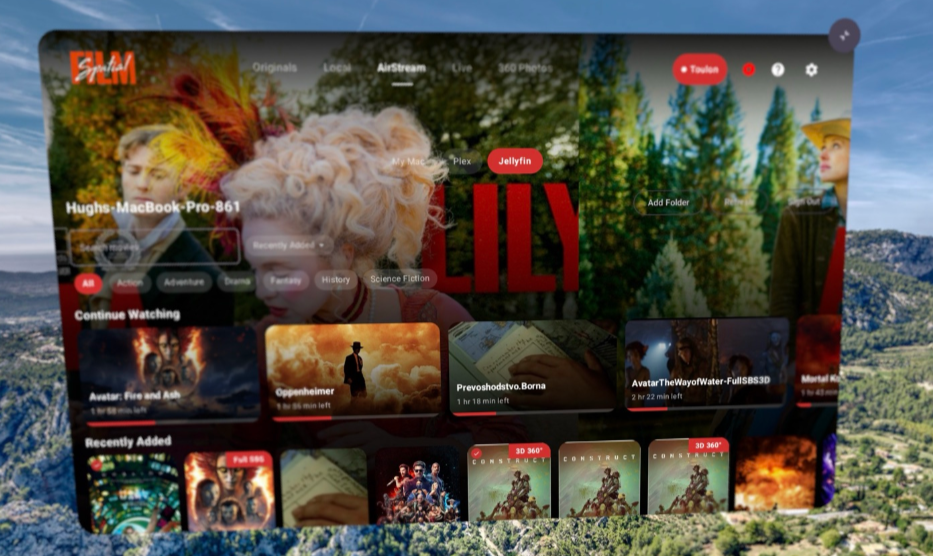
There is a documentation mismatch: the website focuses on Galaxy XR and says Apple spatial formats are absent from the Android version. MV-HEVC support is therefore a developer claim in the store listing that still needs verification with actual files on each device.
Likewise, MKV support does not establish Blu-ray 3D compatibility. An SBS movie and an MVC-encoded Blu-ray 3D backup have different playback requirements; these sources do not confirm MVC, ISO or disc-playlist support.
The practical benefit is access to an existing stereo library without reconstructing depth from a 2d image. Supporting SBS is useful today, while reliable MV-HEVC interoperability would help move beyond device-specific preparation and duplicate versions of the same film.
Vision Pro becomes more useful for viewers and creators
Apple’s visionOS 27 improvements include turning panoramas into spatial scenes, personal Environments, curved windows, previews of Mac-based 3D models and more immersive Safari experiences.
These developments were introduced during the year. The jEarpo Tech video about visionOS 27 on the M2 Vision Pro adds a user perspective after the final release. Its description highlights a more polished experience than the beta and covers features including 4K recording, environments and Mac integration. That is the author’s assessment, rather than an independent performance benchmark.
For creators, Apple’s developer documentation confirms that Spatial Preview connects Mac applications with Vision Pro to review spatial photos, Apple Immersive Video and 3D content. Shortening the loop between editing and inspecting the result in a headset could be particularly valuable for stereoscopic production.
Some distinctions remain essential. Curving a virtual screen does not add stereoscopic depth to the picture. Apple TV’s Multiview means watching multiple feeds simultaneously, rather than the multiview video coding used by MV-HEVC.
Blackmagic builds towards live immersive production
The production side is developing too. Announced in April, Blackmagic’s URSA Cine Immersive 100G combines dual 8K × 8K RGBW sensors running at 90 fps, stereoscopic 180-degree optics, 16 stops of dynamic range and 100G Ethernet for SMPTE 2110 production.
The URSA Live Encoder prepares ProRes video for that IP workflow. The 100 Gbit/s figure concerns professional production infrastructure; it is not the internet connection a viewer would need at home.
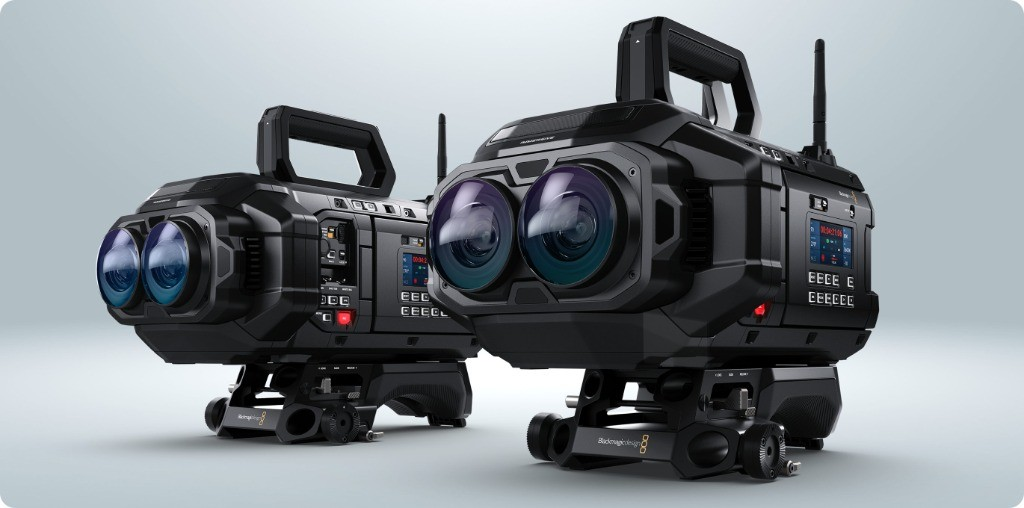
This makes live stereoscopic concerts and sports a more concrete production prospect. Cameras alone do not establish a viewing service: production, distribution, rights and regional access still have to come together.
For 3D audiences, the important development is the ability to originate live footage with two properly captured viewpoints, rather than merely placing a conventional broadcast inside an immersive environment.
Steam Frame should revisit what was “on the list”
According to Tom Giardino’s remarks reported by MIXED, many Steam Frame owners use the headset to play conventional games. His October 27 comments make Valve’s earlier position on stereoscopic content especially relevant.
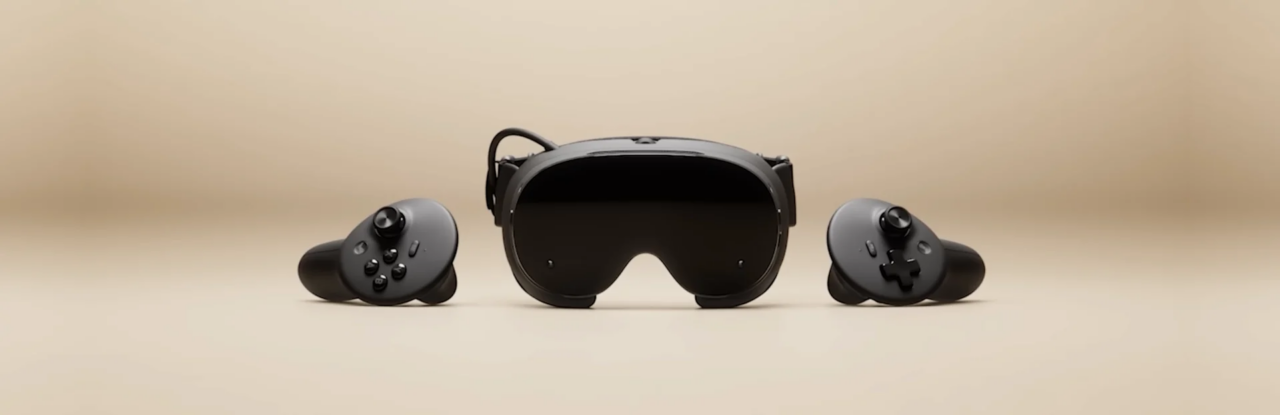
As we reported in December 2025, Valve said stereoscopic 3D support was “on our list.” The proposed system-level implementation could display stereo games, videos and photos, with the aim of supporting both PC-streamed and locally rendered content if the feature were developed.
Since the launch, Steam Frame has become the 6th most popular VR Headset, a remarkable hit for a headset with less than 2 months on the market.
The case for revisiting it has become stronger. If people already use Frame for conventional games, a straightforward way to display compatible stereoscopic output would give those games an extra dimension while preserving their controls, pacing and original design. Clear support for developers and compatible third-party tools could broaden the possibilities further.
A game does not need to become VR to benefit from stereoscopic 3D.
These developments show how spatial computing can become more useful through the content it supports. Native stereoscopic films, spatial games, accessible media libraries and better production tools all give people more reasons to use their devices. The next step is making those experiences easier to access across platforms—and ensuring that familiar games and entertainment can benefit from genuine depth, too.