
At IFA 2026 we found some interesting new 3D displays, including Samsung’s enormous MicroLED and TCL’s new 8K 3D monitors. We thought we had seen them all.
Apparently, we missed one.
And ironically, it came from a company whose 3D products we know particularly well: Acer.
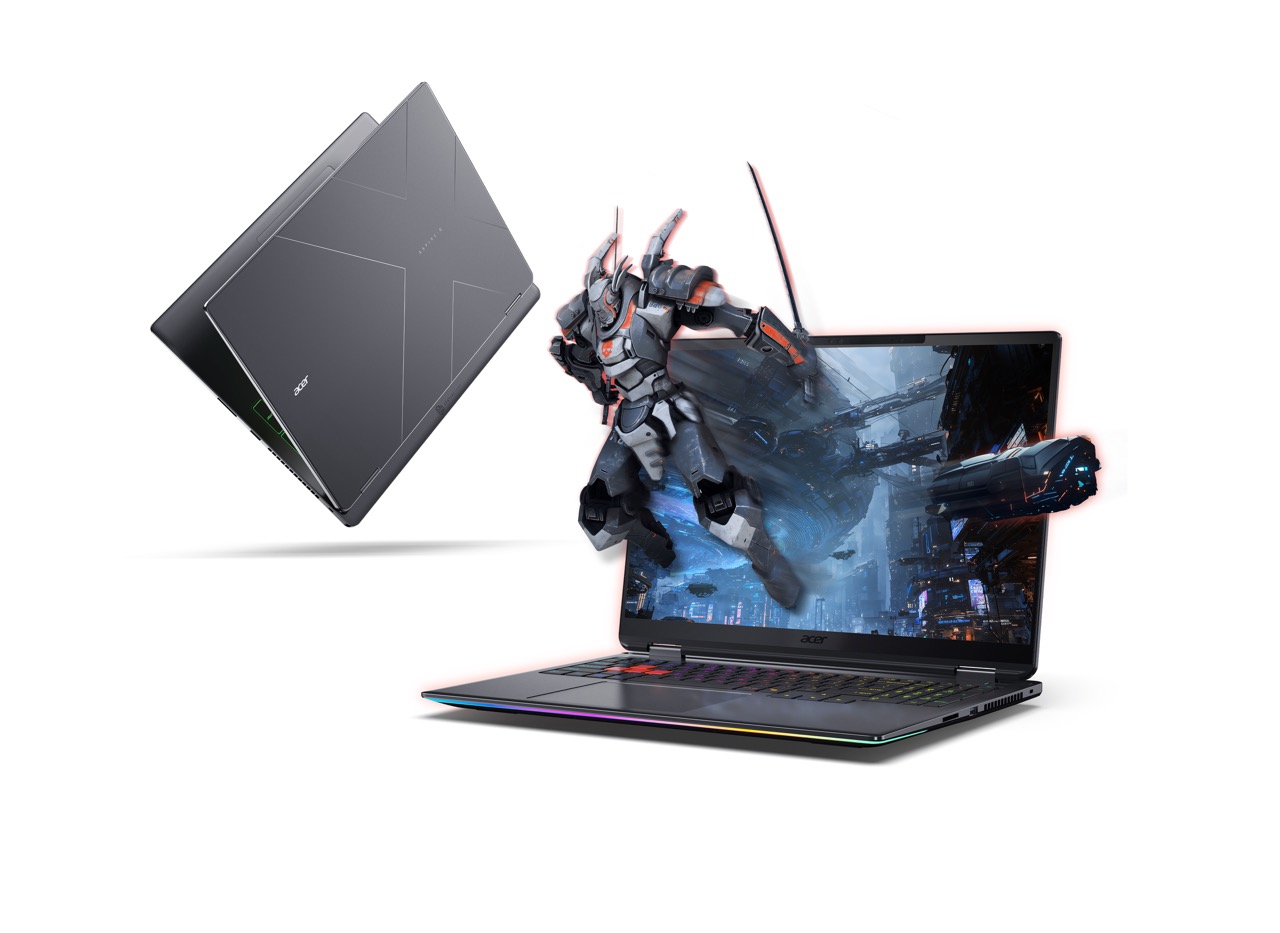
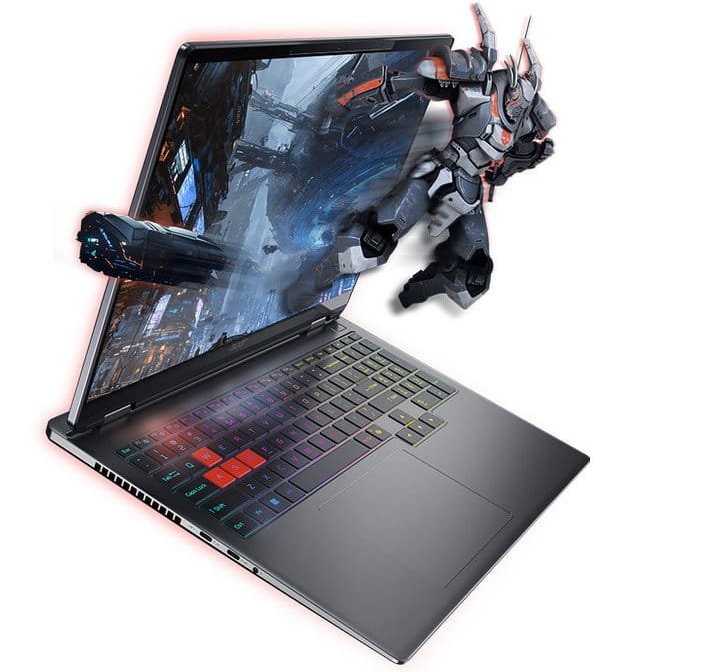
The Acer Aspire G 3D 16 (AG3D16-81M) is a 16-inch glasses-free 3D laptop with eye tracking, a 3840×2400 display, AMD’s extremely powerful Ryzen AI Max+ 395 processor and up to 128 GB of unified memory.
But its specifications are only part of what makes it interesting.
Perhaps the biggest surprise is simply the name written on it:
Aspire.
Not ConceptD. Not SpatialLabs. Not Predator.
Just Aspire.
And that could be much more significant than it initially appears.
From ConceptD to SpatialLabs… and now Aspire?
When Acer first demonstrated what would eventually become SpatialLabs, it did so through its ConceptD family, a range specifically targeted at designers and professional creators.
SpatialLabs subsequently developed an identity of its own. We have seen dedicated SpatialLabs displays, professional products and eventually gaming-oriented devices such as the Predator SpatialLabs View 27.
The technology evolved from an experimental feature for specialists into a complete ecosystem of glasses-free stereoscopic displays, software, games and real-time content conversion… And even a 3D camera.
The Aspire G 3D 16 takes a surprisingly different approach.
Acer has placed the technology inside Aspire, one of its mainstream PC families.
It isn’t even a Predator laptop specifically targeted at gamers.
That raises an intriguing possibility.
Has glasses-free 3D finally matured enough for Acer to stop treating it exclusively as a product category and start treating it as a feature?
That would arguably be one of the best things that could happen to 3D.
A customer would no longer necessarily have to go looking specifically for “a 3D computer” or “a SpatialLabs computer”. They could choose an Aspire because they like its processor, display, battery, AI capabilities or overall specifications — and 3D would simply be another feature included with it.
Just like HDR, a touchscreen or a high-resolution display.
This is not enough to claim that Acer is abandoning SpatialLabs as a dedicated family. In fact, as we will see later, the evidence increasingly points towards something slightly different: Acer may be quietly building an alternative line of products using 3D alongside its existing SpatialLabs devices.
And that could be even more interesting.
This is not your usual integrated GPU
Acer has also made an equally interesting decision inside the computer.
There is no discrete NVIDIA or AMD GPU.
Instead, almost everything is concentrated inside the AMD Ryzen AI Max+ 395.
This is a 16-core, 32-thread Zen 5 processor incorporating a Radeon 8060S GPU with 40 RDNA 3.5 compute units and an XDNA 2 NPU capable of up to 50 TOPS. AMD rates the complete processor for up to 126 TOPS of combined AI processing.
And this isn’t just another integrated GPU. The Radeon 8060S is one of the most powerful integrated graphics solutions in the world — AMD itself describes it as the world’s fastest integrated graphics for gaming.
Calling the Radeon 8060S “integrated graphics” is technically correct, but creates entirely the wrong impression.
This is not an ordinary laptop iGPU intended primarily to save battery while browsing the web.
Depending on the laptop, power limits and workload, the Radeon 8060S can get surprisingly close to NVIDIA’s GeForce RTX 4070 Laptop GPU in conventional rasterized graphics. It does not always reach RTX 4070 performance — particularly with higher-powered implementations and in workloads where NVIDIA has an architectural advantage — but its performance is much closer to RTX 4070 Laptop territory than the words “integrated graphics” would suggest.
And all of that graphics hardware is already inside the processor.
That is particularly significant for 3D.
Rendering stereoscopic games effectively requires generating two viewpoints. Previous high-performance SpatialLabs computers therefore made perfect sense as relatively expensive machines equipped with powerful discrete GPUs.
The Aspire G 3D 16 changes that equation.
Acer can now build a genuinely powerful 3D computer around one highly integrated processor package, instead of combining a high-performance CPU with a separate expensive GPU and its dedicated memory.
That potentially means fewer components, simpler cooling, lower weight and considerably better power efficiency.
The Aspire G 3D 16 weighs only 1.8 kg despite its 16-inch display and enormous 99.9 Wh battery.
Gaming and AI in the same chip
There is another reason why this particular processor makes so much sense.
The Radeon 8060S is only one part of the Ryzen AI Max+ 395.
Alongside the CPU and GPU sits a dedicated 50-TOPS XDNA 2 neural processing unit, giving Acer dedicated hardware for AI workloads without taking away the GPU that needs to render a game — or potentially two stereoscopic viewpoints.
NVIDIA still has an important advantage here: CUDA.
A GeForce RTX 4070 Laptop provides 4,608 CUDA cores, fourth-generation Tensor Cores and NVIDIA rates it for 321 AI TOPS. CUDA also has an enormous established software ecosystem that AMD cannot simply reproduce by putting an NPU inside its processor.
But those numbers do not tell the whole story.
AMD combines its NPU with the Radeon GPU and CPU for up to 126 overall TOPS, while its ROCm ecosystem is increasingly opening the Radeon GPU to local AI workloads.
More importantly, Ryzen AI Max has another weapon that can matter more than raw compute when running large AI models:
memory.
Up to 128 GB of unified memory
The Aspire G 3D 16 can be configured with an extraordinary 128 GB of LPDDR5X-8000 unified memory.
That word — unified — matters.
A conventional gaming laptop with an RTX 4070 normally has separate system memory and 8 GB of dedicated GDDR6 VRAM. The GPU cannot simply turn 64 or 96 GB of the computer’s RAM into equivalent high-speed VRAM whenever an AI model needs it.
Ryzen AI Max is architecturally different.
Its CPU and integrated Radeon GPU share the same high-bandwidth memory pool, and AMD allows as much as 96 GB to be allocated as graphics memory on 128 GB configurations.
That creates an unusual machine.
For many conventional AI tasks, an NVIDIA GPU may still be preferable because of CUDA support, mature software and faster specialized processing. But local generative AI frequently encounters another hard limit: whether the model fits into GPU-addressable memory at all.
AMD itself promotes Ryzen AI Max systems running very large local language models precisely because of this architecture, and its own Ryzen AI Halo development platform pairs the same processor family with 128 GB of unified memory for local AI development.
So this Aspire is potentially much more than a gaming laptop that happens to have 3D.
It combines a 16-core workstation CPU, powerful gaming GPU, dedicated neural processor, huge unified memory pool and glasses-free 3D display in one relatively lightweight machine.
And without the usual discrete-GPU power penalty
There is another consequence to putting all of this into the same processor: power consumption.
An RTX 4070 Laptop GPU alone can operate across a very wide 35–115 W power range. That is the GPU before adding the laptop’s CPU and the rest of the system.
AMD specifies the entire Ryzen AI Max+ 395 package — CPU, Radeon GPU and NPU together — within a configurable 45–120 W envelope.
That does not mean the Aspire will always consume dramatically less power than every RTX 4070 laptop while delivering identical performance. Actual power limits, cooling and workloads matter enormously, and we will need the real machine to test battery life properly.
But the architectural advantage is obvious.
Acer doesn’t have to power and cool a high-performance CPU and a separate high-performance GPU, each surrounded by its own supporting hardware and memory.
Combined with that huge 99.9 Wh battery, the Aspire G 3D 16 could be a particularly interesting portable 3D gaming machine.
We will be very interested to see how long it can actually play in 3D away from a power outlet.
But the display may be the most interesting specification of all
Buried in Acer’s specification table is a number that almost everyone reporting on the Aspire G 3D 16 seems to have overlooked.
The 16-inch IPS panel has a native resolution of:
3840 × 2400 in 2d
and Acer explicitly specifies:
1920 × 2400 in 3D
Look carefully at those numbers.
Only one dimension has been divided between the two stereoscopic views.
The full 2400-pixel vertical resolution remains intact.
That is potentially a major improvement in perceived 3D sharpness.
Lenticular optics themselves aren’t new to SpatialLabs — they have been part of Acer’s technology since the original ConceptD demonstrations — but this particular resolution distribution is extremely interesting.
Acer is unusually explicit here: 1920×2400 in 3D mode.
That gives the stereoscopic image approximately 4.6 million addressable pixels per view according to Acer’s stated resolution.
For perspective, a conventional 1920×1080 image contains only around 2.07 million pixels.
In other words, the stated 3D resolution contains more than twice as many pixels as Full HD — on a 16-inch screen.
And this matters enormously for glasses-free 3D.
One of the compromises of autostereoscopic displays has always been that their underlying panel resolution has to be distributed between different viewpoints. The higher the effective resolution reaching each eye, the less the user has to trade conventional image sharpness for stereoscopic depth.
We already know from extensive use of the SpatialLabs View 27 how important optical quality and resolution are to the final 3D experience.
Here Acer is giving us a remarkably attractive figure.
Whatever unanswered questions remain about software, game compatibility or AI conversion, 1920×2400 in 3D is an actual specification published by Acer.
And for us, it may be the single most interesting confirmed characteristic of this laptop.
We very much want to see that display in person.

SpatialLabs 3D Hub: now we know it isn’t just a new name
Initially, one detail about the Aspire G 3D 16 was particularly mysterious.
Acer didn’t say that it came with the familiar SpatialLabs Experience Center.
It didn’t specifically mention TrueGame, SpatialLabs Go or SpatialLabs Player, either.
Instead, Acer called its software:
SpatialLabs 3D Hub.
At first, it would have been reasonable to wonder whether this was simply the future replacement for Experience Center.
But there is now more evidence.
Acer has an official page dedicated specifically to SpatialLabs 3D Hub, and it describes a somewhat different ecosystem.
3D Hub integrates a 3D Media Player, 3D Model Viewer, real-time AI-powered Intelligence 3D conversion and a new gaming environment.
And its gaming catalogue is not described in terms of the familiar TrueGame library.
Acer currently advertises support for Tencent titles and more than 50 Steam games, with more coming.
It also explicitly identifies several games that operate through something called 3D Spatial Gateway, including Arena Breakout: Infinite, Path of Exile 2, Delta Force and others depending on the region.
Acer says 3D Spatial Gateway is activated through the 3D Hub application, but does not yet explain publicly enough about what happens technically underneath for us to describe exactly how this system generates stereoscopic views.
The important point is that 3D Hub appears to be more than a renamed Experience Center.
Is Acer quietly building an alternative 3D product line?
And here’s where things become particularly interesting.
The Aspire G 3D 16 is not actually the first Acer device using SpatialLabs 3D Hub.
We have discovered another recent Acer 3D product using the same new ecosystem — and, interestingly, that product doesn’t carry SpatialLabs in its product name either.
We will talk much more about that device very soon.
For now, its existence changes how we interpret the Aspire.
Rather than immediately replacing SpatialLabs Experience Center, 3D Hub may be the software foundation of an alternative line of Acer 3D products.
Products that take years of technology developed through SpatialLabs but integrate it into Acer’s existing product families instead of requiring the customer to buy a specialized “SpatialLabs product”.
That would explain several things at once.
The different software.
The different gaming catalogue.
The use of AMD hardware.
And even the product name.
The original SpatialLabs ecosystem can continue serving the dedicated SpatialLabs hardware we already know, with its mature TrueGame catalogue and specialized features, while 3D Hub can provide a more condensed, hardware-flexible environment for devices where 3D is one important feature among many.
We should stress that Acer has not officially described the strategy in those terms. It is also possible that 3D Hub represents the beginning of a broader software transition that could eventually reach existing SpatialLabs hardware.
But we now know enough to say that it isn’t exclusive to this Aspire.
There is another new Acer 3D product using it.
And that makes the pattern much harder to ignore.
Different SpatialLabs catalogue?
This also changes the question we originally had about games.
Acer says that on the Aspire G 3D 16:
“In supported games, 3D depth also helps scenes feel more dimensional.”
Previously, the obvious question would have been whether “supported games” simply meant Acer’s existing TrueGame catalogue.
Now it isn’t so obvious.
SpatialLabs 3D Hub has its own advertised gaming support, comprising more than 50 Steam games alongside Tencent titles and games accessed through 3D Spatial Gateway. This contrasts with the current 253 games available in TrueGame.
So when Acer talks about “supported games” on this Aspire, it may be referring to that new 3D Hub ecosystem rather than TrueGame.
That would also make sense technically.
TrueGame was developed around the hardware ecosystem of previous SpatialLabs machines, while this Aspire is doing something unprecedented for an Acer glasses-free 3D gaming laptop:
running entirely on AMD integrated graphics.
The Radeon 8060S clearly has enough raw graphics performance for serious gaming. The more interesting question is how Acer’s new stereoscopic software stack works with it.
Does 3D Spatial Gateway obtain real geometric information from compatible games?
Are the 50+ Steam titles using individual profiles?
How many games rely instead on Intelligence 3D conversion?
Can unsupported games simply be converted in real time?
At the moment, Acer doesn’t provide enough technical information to answer all of those questions.
But it is increasingly clear that we should not simply assume 3D Hub = TrueGame with a different icon.
“Bypassing the need for native 3D content”
And then there is perhaps the most intriguing sentence in Acer’s entire Aspire announcement.
Acer says the laptop can provide its 3D experience:
“while bypassing the need for native 3D content and a discrete GPU.”
The discrete-GPU part is now easy to understand.
The Radeon 8060S explains it.
But the first half of that sentence deserves much more attention.
Why specifically emphasize that it bypasses the need for native 3D content?
The official 3D Hub page gives us an important clue.
Acer calls its new conversion system Intelligence 3D, describing it as advanced AI that converts standard 2d photos and videos into 3D in real time.
So 2d-to-3D conversion isn’t merely an incidental compatibility feature in 3D Hub.
Acer is explicitly presenting AI conversion as one of its four main pillars.
That makes the Ryzen AI Max+ 395 inside the Aspire particularly intriguing.
Current SpatialLabs hardware already provides real-time 2d-to-3D conversion, including the ability to enjoy content and many games without requiring native stereoscopic rendering. One of its greatest strengths is its relatively small performance penalty, although in our experience its conversion quality has remained behind some competing solutions.
Now Acer has paired its new AI-focused conversion environment with a processor containing not only a powerful Radeon GPU, but also a dedicated 50-TOPS neural processor.
The obvious question practically asks itself:
Is Intelligence 3D using that NPU?
And if so, has Acer managed to improve depth estimation while retaining the excellent performance characteristics of its previous conversion?
Imagine using the Radeon 8060S primarily to render the game while the XDNA 2 NPU helps reconstruct its depth in real time.
Architecturally, it would make enormous sense.
But we need to be very clear: Acer has not said that this is how Intelligence 3D works on the Aspire G 3D 16.
The NPU connection is currently our hypothesis, not a confirmed specification.
Intelligence 3D may use the Radeon GPU, the NPU, some combination of both, or a different implementation depending on the content.
What Acer has confirmed is already interesting enough: the computer has a powerful dedicated NPU, 3D Hub uses AI for real-time 2d-to-3D conversion, and Acer specifically promotes the Aspire as eliminating the requirement for native 3D content.
That is something we definitely want to test.
Perhaps the most important SpatialLabs development isn’t called SpatialLabs
The Aspire G 3D 16 leaves us with a surprising number of questions.
How does 3D Spatial Gateway work?
Which of the 50+ games are available on the Aspire?
Can virtually any game be converted using Intelligence 3D?
Has conversion quality improved?
Does Intelligence 3D use the XDNA 2 NPU?
And will SpatialLabs 3D Hub remain an alternative ecosystem or eventually replace Experience Center on existing hardware?
But even without those answers, something interesting appears to be happening at Acer.
SpatialLabs began inside the specialist ConceptD ecosystem.
It later became a recognizable family of specialized 3D products in its own right.
Now Acer has taken the knowledge and technology accumulated through SpatialLabs and put 3D inside an Aspire.
Not an experimental prototype.
Not a professional visualization workstation.
Not a dedicated SpatialLabs product.
Not even a Predator gaming laptop.
An Aspire.
Maybe this is simply another way for Acer to sell a handful of 3D devices.
But there is a much more interesting possibility.
Perhaps Acer no longer believes that 3D needs to define the product. Perhaps 3D can simply be one of its features.
If so, that’s exactly the kind of normalization stereoscopic 3D needs.
And apparently, the Aspire G 3D 16 isn’t the only new Acer product suggesting exactly that.
More about Acer’s new 3D products very soon.