
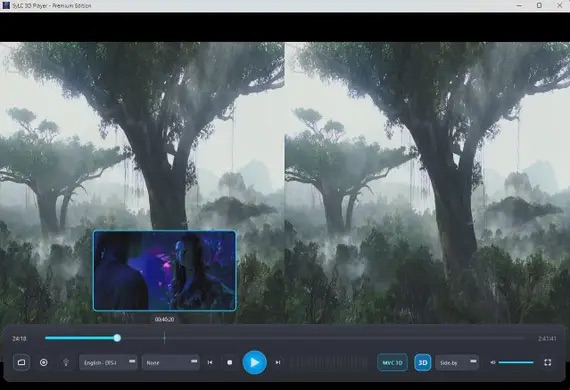
3D Blu-ray collections are not dead — but playing them properly on a modern PC has become unnecessarily difficult. SyLC 3D Player is a new free and open-source project specifically designed to solve that problem, decoding both views of MVC video and outputting real frame-packed 3D on modern Windows systems. And it goes considerably further, with HDR support, direct Blu-ray and ISO playback, Full-SBS, AI 2d-to-3D conversion and more.
We recently wrote about Oku3D, a modern player that finally brings together the increasingly diverse world of 3D media, displays and headsets in a contemporary interface.
Now another new project is attacking a very different problem.
And this one goes directly to the heart of one of the most important formats in the history of home 3D: MVC, the format behind 3D Blu-ray.
Its name is SyLC 3D Player, and it is free and open source.
The strange problem with playing a 3D Blu-ray today
A commercial 3D Blu-ray does not normally store its movie as a Half-SBS or Full-SBS video.
Instead, Blu-ray 3D uses Multiview Video Coding (MVC), an extension of H.264/AVC designed to efficiently store multiple views.
Rather than simply encoding two completely independent full-resolution videos, MVC contains a base view together with the additional information required to reconstruct the second view. This avoids much of the unnecessary duplication that would result from independently encoding two very similar images.
It is an elegant and efficient solution.
But today it also presents a frustrating problem.
Many modern video players rely on FFmpeg and related decoding pipelines that do not provide the complete MVC stereoscopic playback needed here. They can decode the H.264 base view, meaning that your video technically “works” — but you see only one eye.
The movie plays.
The 3D doesn’t.
This is particularly ironic because all the information needed for full-resolution stereoscopic playback is still sitting there inside the file.
SyLC was created specifically to solve that problem.

What about 3D Blu-ray rips made with MakeMKV?
This problem will be particularly familiar to anyone who has backed up a 3D Blu-ray collection using MakeMKV.
MakeMKV can preserve the original MVC 3D video when ripping a Blu-ray into an MKV file, retaining the full-resolution base and dependent views rather than converting the movie to SBS or another stereoscopic format.
The problem comes afterwards.
Having an MVC stream inside an MKV does not mean that every device or application capable of opening MKV files can actually play it in 3D. Some players simply decode the standard H.264/AVC base view and ignore the MVC dependent view, resulting in perfectly playable video — but only in 2d. Hardware Blu-ray players can present another compatibility hurdle: a device may support 3D Blu-ray discs while having much more limited support for MVC when the same video is stored inside an MKV file.
As a result, many enthusiasts have perfectly preserved 3D backups that are considerably more difficult to play than they should be.
SyLC addresses precisely this situation: an MVC MKV created with MakeMKV can remain MVC and be decoded as 3D, without first converting the movie to SBS just to make it playable.
This proves why 2d and 3D never needed separate files — or SBS: a single file can preserve the full 3D experience while remaining perfectly usable in 2d, even when other players only understand 2d and almost everyone else is watching it in 2d.
MVC is back
SyLC provides an MVC-capable decoding pipeline that reconstructs both the base and dependent views and presents them as actual stereoscopic video.
That means an MVC MKV ripped from a 3D Blu-ray can remain MVC.
There is no need to convert your movie to SBS just because modern playback software has forgotten how to deal with the original stereoscopic format.
SyLC currently supports MVC in MKV as well as raw SSIF and M2TS streams, and it can go considerably further: you can point it directly at a Blu-ray disc, a BDMV folder or a Blu-ray ISO.
When opening a complete Blu-ray structure, the player can automatically identify the main feature and prioritize its 3D SSIF stream.
For enthusiasts with large 3D Blu-ray collections, this alone makes SyLC an extremely interesting project.
Real frame-packed 3D output
Decoding both eyes is only half of the problem.
They still have to reach the display correctly.
SyLC can generate frame-packed stereoscopic output, placing the two full-resolution views into the appropriate output structure for compatible 3D displays.
This is particularly relevant to users who still have 3D TVs, projectors and other devices capable of receiving frame-packed 3D.
Instead of decoding MVC only to convert the result into a reduced or rearranged distribution format, SyLC can preserve the complete stereoscopic image through the playback chain.
An embedded 2d preview remains available in the main interface, while the actual stereoscopic frame-packed image can be sent to a separate display window.
Full-SBS content is supported as well.
And yes, there is HDR
This is where things become especially interesting.
SyLC’s rendering pipeline is based on Direct3D 11, with decoded video frames sent to the GPU and processed through a 16-bit floating-point scRGB HDR surface.
According to the project documentation, HDR10/PQ information can therefore be preserved throughout the rendering chain rather than being converted to SDR before reaching the display.
In other words, SyLC combines stereoscopic 3D and modern HDR rendering in the same playback pipeline.
But an important distinction needs to be made here.
This does not magically make existing commercial 3D Blu-rays HDR.
The Blu-ray 3D movies we already own were authored as SDR content. SyLC cannot recover HDR information that was never contained in the source.
What it does mean is that SyLC’s 3D architecture is not inherently restricted to the SDR limitations associated with the original Blu-ray 3D ecosystem. If the source contains compatible HDR information, the player has a rendering path designed to preserve it.
That distinction makes SyLC much more interesting than simply calling it a “3D Blu-ray player with HDR”.
It is a modern 3D playback engine that happens to understand the old MVC format as well.
“Old” 3D format, modern rendering pipeline
That combination is arguably the most interesting aspect of the whole project.
Blu-ray 3D dates back to an era when home stereoscopic video was built around HDMI 1.4, dedicated 3D televisions, hardware Blu-ray players and software such as PowerDVD.
SyLC approaches that content using a modern software architecture.
MVC decoding is handled through an extended edge264 H.264 decoding pipeline, while rendering is performed through native Direct3D 11.
The decoded YUV planes are uploaded directly to the GPU, where a shader performs the conversion to RGB and assembles the stereoscopic frame.
For HDR sources, this process can remain inside a high-precision HDR pipeline rather than making an intermediate trip through SDR.
So while the source format may date from the original 3D Blu-ray era, the software processing it certainly does not.
Play a disc, folder, ISO or MKV
One particularly welcome aspect of SyLC is that users do not have to reorganize their entire collection around the player.
Current versions can work with:
- 3D MVC MKV files
- Blu-ray SSIF streams
- M2TS
- BDMV folders
- Blu-ray ISO images
- Physical Blu-ray discs
- Full-SBS video
- Conventional H.264 video
- Other conventional video formats through fallback playback
Opening an ISO does not require manually mounting it beforehand. SyLC can access the image, locate the Blu-ray structure and identify the main feature.
The project can even create a byte-for-byte ISO image from a Blu-ray disc directly inside the player, providing an additional way for collectors to preserve their physical 3D libraries.
That last feature feels particularly appropriate for a project like this.
SyLC is not merely about watching 3D Blu-rays. It is also about ensuring that collections built during the commercial 3D era remain usable as the hardware and software originally designed to play them gradually disappears.
Even real-time AI 2d-to-3D conversion
Surprisingly, SyLC does not stop at native stereoscopic material.
The player also includes real-time AI 2d-to-3D conversion.
Its current implementation uses Depth Anything V3 to estimate depth from conventional video frames. The renderer then synthesizes the second eye from that depth information.
Several quality modes are available, trading inference resolution and update frequency against performance, while temporal stabilization and scene-cut handling attempt to prevent depth from flickering or carrying incorrectly from one shot into the next.
The required AI models are optional downloads, so users interested only in native 3D playback do not have to install several gigabytes of neural-network data.
It is almost amusing that a player created to rescue one of the oldest mainstream digital stereoscopic formats also incorporates one of the newest approaches to generating 3D.

Why SyLC matters
For years, the evolution of 3D software appeared to be moving in the wrong direction.
The hardware remained in people’s homes. The discs remained on their shelves. The video files remained on their hard drives.
But software support gradually disappeared.
This created the absurd situation where a perfectly preserved MVC movie could contain two full-resolution stereoscopic views, yet opening it in a modern general-purpose media player could result in nothing more than an ordinary 2d image.
The data had survived.
The ability to use it had not.
This is why open-source projects such as SyLC are important beyond their immediate feature list.
A proprietary player can disappear when its developer loses interest, its activation servers are shut down, operating-system compatibility breaks or the company simply decides that 3D is no longer commercially relevant.
An open-source decoder does not have to share the same fate.
The code can be studied, modified, ported and maintained by others.
For a format that the mainstream consumer-electronics industry has largely abandoned while enthusiasts continue to use it every day, that distinction matters enormously.
2026 is becoming a surprisingly good year for 3D software
There is also a wider trend here that is becoming difficult to ignore.
Only recently, we covered Oku3D, another new player created specifically for today’s much broader 3D ecosystem.
Oku3D and SyLC are not the same thing, nor should one simply be considered a replacement for the other.
Oku3D approaches the problem as a modern, versatile 3D media platform supporting a wide range of stereoscopic content and display technologies.
SyLC is particularly fascinating because it dives deep into one of the most technically neglected areas of modern 3D playback: proper MVC decoding and frame-packed output from 3D Blu-ray sources.
The fact that we can now write about two actively developed 3D players within such a short period is itself noteworthy.
For a format that is supposedly “dead”, developers seem unusually busy.
Bridging two generations of 3D
Perhaps the best way to understand SyLC is not as software designed to recreate the 3D ecosystem of 2012.
It is software designed to bring its content forward.
It takes MVC, SSIF, BDMV structures, ISO images and frame-packed stereoscopic video from the Blu-ray 3D generation and puts them inside a software environment built for current PCs, GPUs and operating systems.
It combines them with HDR-capable rendering, modern GPU processing and even AI-generated depth.
That is exactly the kind of development the 3D community needs.
Preserving 3D should not mean preserving an old computer forever, keeping an obsolete version of Windows disconnected from the Internet, or hoping that discontinued commercial software continues to activate.
The content itself remains perfectly valid.
What it needed was modern software capable of understanding it again.
SyLC does not ask us to leave Blu-ray 3D behind in order to move forward. It brings Blu-ray 3D with us.