
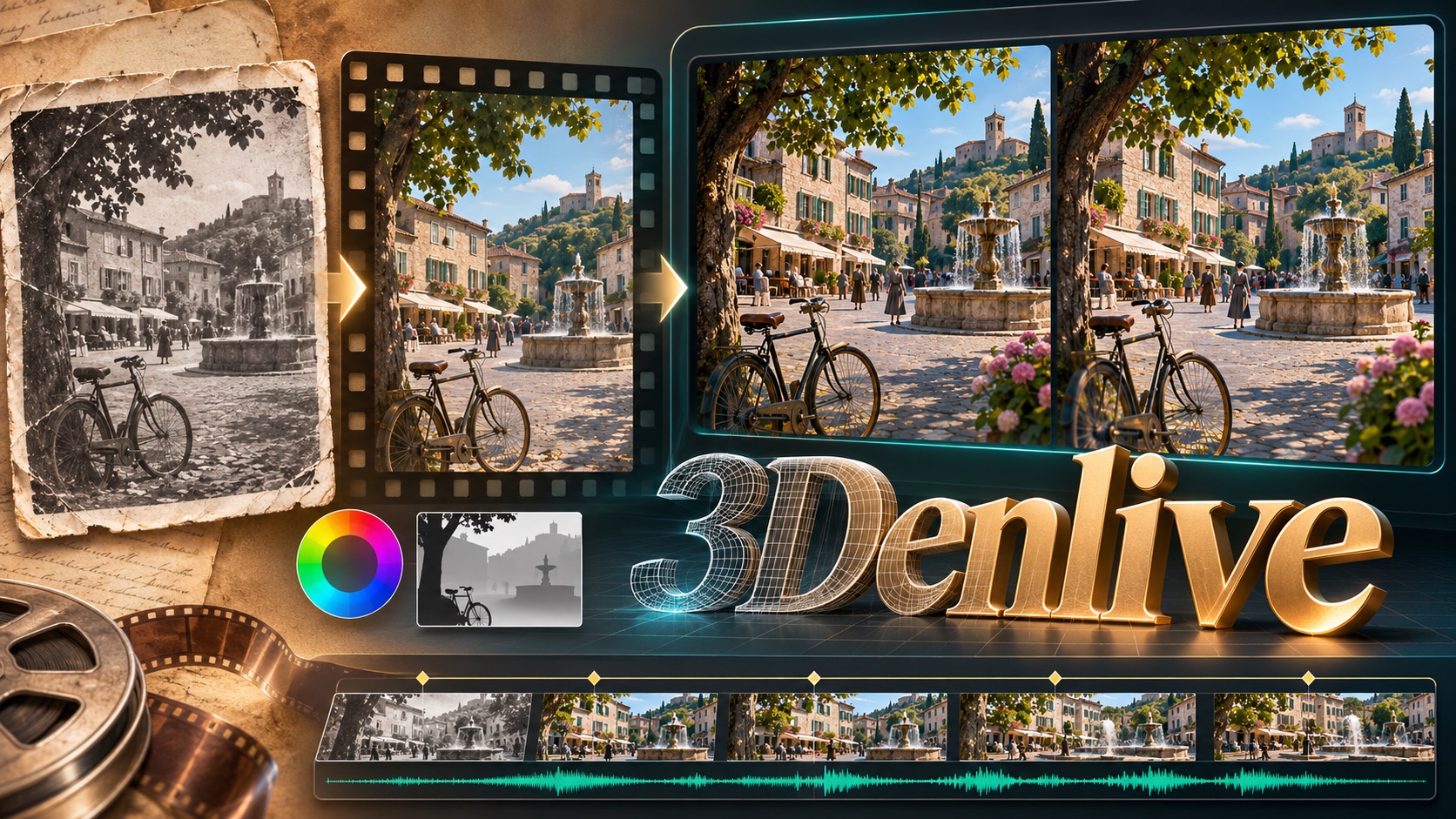
Colourise an old photograph, bring it to life, turn it into stereo and add animated 3D titles: 3Denlive brings together creative tools more commonly found across separate 2D workflows.
Many of the most exciting developments in AI imaging have revolved around flat images and conventional video. Colourisation, image-to-video generation and synthetic sound have opened new creative possibilities, but stereoscopic creators often need to move between applications to turn those possibilities into a finished 3D production.
3Denlive is taking a different approach: bringing these tools into an editor built around stereoscopic images and video. Its creator’s demonstrations show how several stages can work together, taking a single black-and-white photograph toward a colour stereo animation, complete with titles that have real binocular depth.
The attraction is the combination. Each individual technique is interesting; having them available within the same creative environment makes a much more ambitious workflow possible. 3Denlive website.
From an old photograph to a new 3D story
Consider a photograph that has spent decades as a small, monochrome print. It contains no recorded movement, no stereo pair and no soundtrack. In a traditional workflow, adding each of those elements could require a separate tool, followed by repeated exports and imports.
The demonstrations published by 3Denlive’s creator, Étienne Monneret, explore a more connected process: colourise the photograph, generate movement, create stereoscopic depth and assemble the result with other visual and audio elements. In one demonstration, he describes producing the video entirely with 3Denlive and its integrated AI tools from a low-quality black-and-white 2D image, including the music. Creator’s demonstration announcement.
That makes old photographs a particularly compelling starting point, but the creative potential extends to illustrations, personal archives and other still images.
The generated result should be understood as an interpretation. Colours, movement and depth inferred from a single photograph are newly created elements, rather than recovered historical information. Used with that distinction in mind, the process offers a fascinating way to revisit familiar material.
Titles you can build and judge in stereo
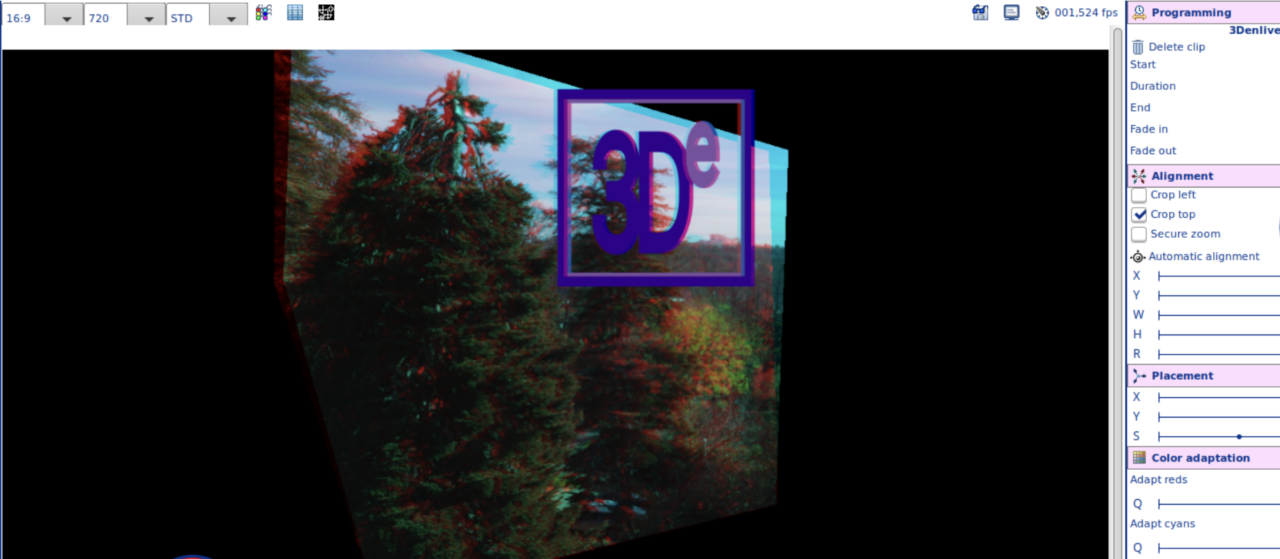
One of 3Denlive’s most distinctive additions is its integrated 3D modeller, demonstrated with objects that can be animated and viewed stereoscopically.
For titles, this goes beyond placing flat lettering at a different depth. A modelled title can have volume and occupy the scene as a three-dimensional object. Viewing it in stereo while editing helps the creator judge its relationship with the background: how far forward it appears, whether its depth is convincing and how it fits into the composition.
This brings an important part of the creative decision into the editing environment. The title’s depth becomes something to design alongside its size, position and movement. Monneret announced the integrated modeller on 11 November, accompanied by a demonstration of animated objects in stereo. 3D modeller announcement.
A stereo editor underneath the AI tools
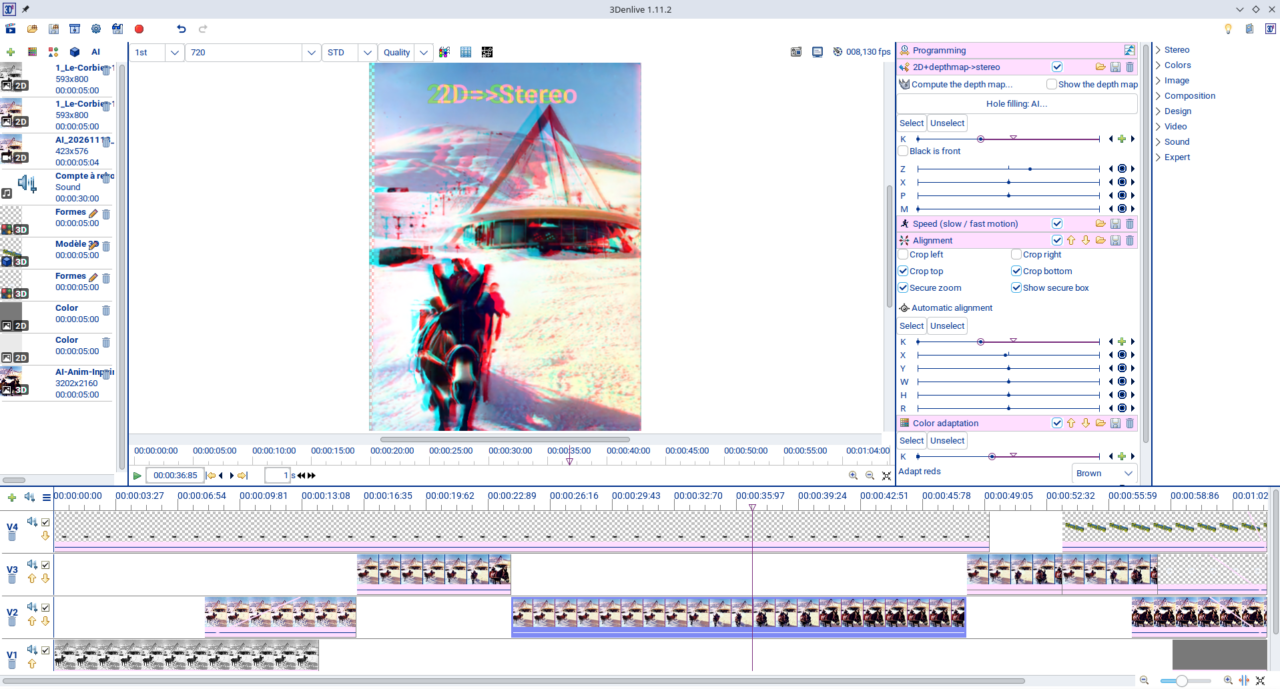
The interface shows that 3Denlive is also a substantial montage environment.
In the supplied screenshot, labelled version 1.11.2, a media bin contains photographs, sound, shapes, a 3D model and generated material. Four visible video tracks hold overlapping clips, while the central monitor displays a stereoscopic preview. On the right, the selected clip has a stack of processors, including 2D-plus-depth-map conversion, speed adjustment, alignment and colour adaptation.
The depth conversion panel includes depth-map computation, an AI hole-filling option and adjustable parameters. Alignment controls provide automatic alignment alongside manual adjustments, cropping and a secure viewing area. Repeated keyframe controls indicate how settings can be varied over time.
These details matter because a generated clip is rarely the final production. It needs to be trimmed, positioned, combined with other material and adjusted to work as part of a sequence. 3Denlive connects generation with the practical work of editing stereo content.
Its public source also includes processors for chroma key, transparency, lens correction, brightness and contrast, hue and saturation, subtitles and other operations. The availability and behaviour of individual tools should still be checked against the build being used. 3Denlive source code.
Sound joins the workflow
The recent development extends beyond images. On 15 November, Monneret announced automatic speech dubbing and generation of music and sound effects contextualised by a reference image.
For a short stereo production, these additions could help connect the visual transformation with an accompanying soundscape. An animated photograph can become part of a narrated sequence, while music and effects contribute atmosphere and structure. The creator has published an example of the dubbing functionality alongside the announcement. Audio tools announcement.
The announcements do not establish the hardware requirements, model dependencies or local-versus-online execution of every AI feature. Those practical details remain important for anyone planning to reproduce the demonstrations.
A community project finding new momentum
There is a personal development story behind this burst of activity. Monneret explains that he stopped working on 3Denlive several years ago because a new professional activity left him short of time. Now he has returned, describing AI-assisted coding as a way to develop new features faster. His 8 November announcement introduced version 1.1 with sound processing and animated shapes; subsequent posts added modelling and generative capabilities. Development restart announcement.
That makes 3Denlive a fitting subject for The Power of the 3D Community. Where StereoFine concentrates on preparing stereo photographs and StereoMate offers extensive editing and presentation options, 3Denlive’s recent demonstrations emphasise a broader creative journey: generating, assembling and animating material directly toward a stereoscopic result.
It is still necessary to test the quality of each stage. Generated movement can introduce inconsistencies, colourisation can invent details and estimated depth can produce uncomfortable edges or missing regions. Integration makes the workflow more accessible; careful stereo review remains part of creating a successful result.
Nevertheless, the possibility is exciting. A faded photograph can become the foundation of a colour 3D sequence with movement, sound and volumetric titles—all brought together in one editor. For community-driven stereoscopic creation, that opens a rich new area to explore.
Explore: 3Denlive website and downloads · Public source repository · Creator’s announcements and demonstrations