NOTE: Xreal promised an upcoming update allowing 60fps content, currently 2D-to-3D conversion works only at 30Hz.
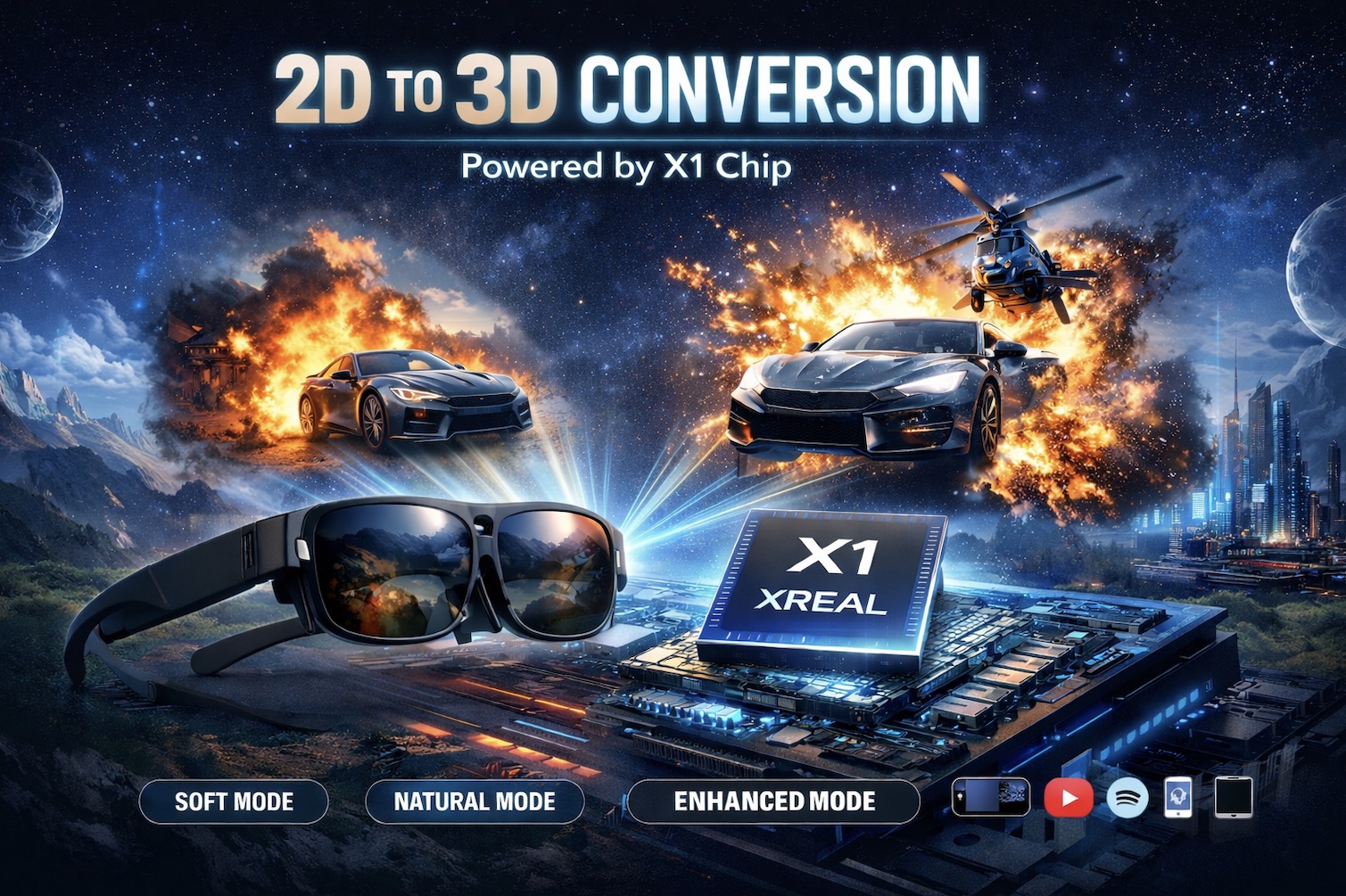
XREAL has introduced a new real-time 2D-to-3D conversion system in its latest glasses lineup, bringing dynamic stereoscopic depth to virtually any flat content source. Unlike software-based solutions that depend on a specific operating system or app, XREAL integrates the conversion directly into the glasses hardware, opening the door to a far more flexible and universal 3D experience.
Below is a detailed look at how the system works, the available depth modes, compatible models, and how it compares to competing solutions like the Viture Luma Ultra.
Conversion Modes
XREAL’s 2D-to-3D conversion includes various selectable depth modes, allowing users to fine-tune the intensity of the stereoscopic effect:
1. Soft Mode
- Very subtle depth.
- Minimal distortion or artifacts.
- Ideal for users sensitive to aggressive 3D effects.
- Best for long viewing sessions or precission content.
2. Natural Mode
- Balanced, convincing depth.
- Designed to minimize visual distortions.
- Suitable for most users.
- The recommended default mode.
3. Enhanced Mode
- More pronounced depth effect.
- Slightly “forced” stereoscopy.
- May introduce minor artifacts in certain scenes.
- Ideal for users who want maximum immersion.
4. Furious Mode
- Very agressive depth
- No limits for artifacts in the algorythm
- This mode would fit better in still images, as video can get strange results.
This tiered approach is particularly important because not all viewers perceive 3D the same way. Offering adjustable intensity makes the system adaptable rather than one-size-fits-all.

Always “Inward” 3D — And Why That’s Fine
One important detail: XREAL’s conversion always renders depth into the screen, rather than producing objects that pop outward toward the viewer.
In practice, this should not be considered a limitation. What matters most in 3D perception is the amount of depth separation, not whether objects protrude forward. In fact, most 3D films use outward “pop-out” effects sparingly, typically reserved for special moments. The majority of stereoscopic content is designed with inward depth for comfort and realism.
XREAL’s approach prioritizes stability and viewing comfort over gimmicky pop-out effects.
There’s a fascinating insight here: what 3D enthusiasts psychologically enjoy as “pop-out” effects actually depends on the position of the display’s frame. A closer—real or virtual—display containing complete in-depth 3D will render images that appear nearer to your eyes than a more distant screen exhibiting stronger pop-out effects. Once you stop focusing on where the screen plane is and instead immerse yourself in the perceived depth of the imagery, the display surface seems to vanish, leaving the images literally floating in front of you.
The Display
XREAL glasses use OLED microdisplays, which are particularly well-suited for stereoscopic viewing: True blacks (no backlight bleed) and High contrast ratios.
3D content benefits tremendously from high contrast and clean separation between depth layers. Dark scenes, in particular, maintain clarity thanks to OLED’s per-pixel illumination.
The XREAL One Pro pushes brightness up to 700 nits, which is more than sufficient for vibrant 3D viewing. Compared to traditional passive or active 3D glasses used with TVs or projectors, this brightness level ensures:
- Strong highlights
- Reduced dimming typical of 3D systems
- Better HDR-like perception
For immersive movie sessions, this makes a noticeable difference.
Compatible Models
The hardware-based 2D-to-3D conversion is available in the XREAL lineup with the X1 chip, including:
- The new Xreal 1S
- XREAL One
- XREAL One Pro
Because the conversion is handled by an integrated chip inside the glasses themselves, compatibility does not depend on Operating system, Specific software, GPU drivers or Special desktop applications
This is one of the most important advantages of XREAL’s implementation.
True Platform Independence
Unlike PC-based conversion systems, XREAL’s hardware conversion works regardless of the connected source device. It works with device with USB-c output (or through and HDMI to USB-c adapter):
- Windows
- Linux
- macOS
- Android smartphones
- iPhones (with compatible adapters)
- Handheld PCs (Steam Deck, ROG Ally, etc.)
- Consoles like PS5, XBOX or Switch
- Streaming platforms (Netflix, Prime Video, Disney+, etc.)
- DRM-protected content

Because the glasses process the stereoscopic transformation internally, DRM restrictions do not interfere with 3D conversion. This dramatically expands usability compared to solutions that require specific desktop software.
In short: if it displays in the glasses, XREAL can convert it.
Comparison: XREAL vs Viture Luma Ultra
The most direct competitor in this space is the Viture Luma Ultra, which also offers 2D-to-3D conversion—but with significant differences.
Viture Luma Ultra – Strengths
- Extremely bright display: 1500 nits
- Excellent color reproduction
- 1200p resolution panel
- Desktop 3D effect can be visually striking
However:
- 2D-to-3D conversion works only on Windows
- Requires proprietary PC software
- Cannot convert DRM-protected streaming apps reliably
- Less flexibility across devices
The 1200p resolution is technically higher than XREAL’s 1080p, but most films, series and games are 16:9 or wider (e.g., 2.39:1 cinemascope), meaning the extra vertical pixels are not fully utilized in movie viewing. The newest Xreal 1S also have 1200p resolution.
The biggest limitation is ecosystem dependence. If you are not using Windows with the specific Viture software, the 3D conversion simply isn’t available.
XREAL – Strengths
- Hardware-based 3D chip
- Works with any device
- Compatible with DRM content
- Stronger, more convincing 3D depth effect
- No dependency on OS or software
If 2D-to-3D conversion is a core reason for buying smart glasses, XREAL currently offers the more robust and versatile solution.
Final Thoughts
XREAL’s new 2D-to-3D conversion is a serious upgrade for 3D enthusiasts. For users who truly enjoy stereoscopic content and want flexibility across platforms, XREAL’s implementation is currently one of the most compelling solutions available.
In short: a high-quality conversion system that makes 2D-to-3D conversion a standard—without the usual restrictions.