

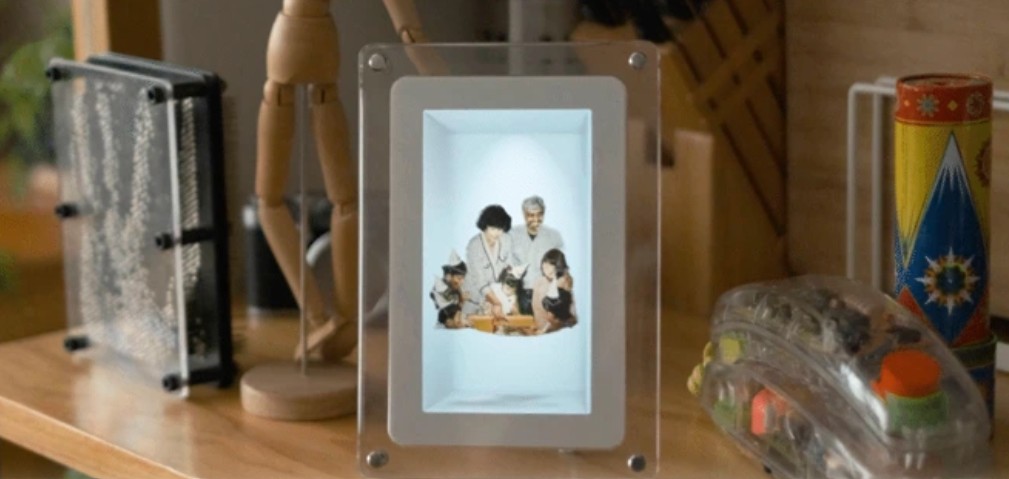
The team at Looking Glass has spent years pushing holographic display technology from experimental novelty to everyday object. Their earlier Looking Glass Go proved that a pocket‑sized, glasses‑free 3D display could be fun, portable, and surprisingly capable. Now, with Musubi, they’re taking a more emotional, home‑centric approach: a holographic photo frame designed to display memories in true depth.
Below is a detailed comparison of how Musubi evolves the concept—and where it stands relative to the Go.
What Musubi is trying to be
Musubi isn’t just a smaller or larger version of previous Looking Glass devices. It’s positioned as:
- A dedicated holographic photo frame, meant to sit on a desk, shelf, or nightstand.
- A passive, always‑on display for photos, portraits, and short clips.
- A consumer‑friendly device that doesn’t require technical knowledge, Unity, or 3D pipelines.

Where the Go was a developer‑friendly gadget, Musubi is a memory‑centric lifestyle product.
Side‑by‑Side comparison
| Feature | Musubi | Looking Glass Go |
|---|---|---|
| Primary Purpose | Holographic photo frame for everyday memories | Portable holographic display for apps, demos, and 3D content |
| Form Factor | Stationary frame, home décor aesthetic | Pocket‑sized, handheld |
| Display Size | Larger, designed for visibility across a room | Small (around smartphone size) |
| Content Type | photos, portraits, short holographic? loops | Interactive apps, 3D models, volumetric videos |
| User Experience | Simple, automatic playback; minimal setup | Requires software, pairing, and content preparation |
| Target Audience | General consumers, families, gift buyers | Developers, 3D artists, tech enthusiasts |
| Connectivity | Likely Wi‑Fi/cloud‑based photo syncing | USB‑C, app‑based content transfer |
| Interactivity | Mostly passive display | Interactive demos, touch‑free UI experiments |
| Software Ecosystem | Focused on photo management and sharing | SDKs, Unity/Unreal integrations, experimental apps |
Musubi use case
The Go was impressive, but it always felt like a tech demo platform—a device you show to friends, not one you leave running in your living room.
1. Designed for Memories
Musubi is built around the idea that photos—especially portrait‑mode images—deserve depth. It turns everyday snapshots into holographic keepsakes.
2. Always‑On, Ambient Display
Instead of requiring interaction, Musubi quietly cycles through your chosen images, like a digital frame but with dimensionality.
3. Social and Shareable
Looking Glass has been leaning into cloud‑based sharing, allowing people to send holographic photos to each other. Musubi is clearly designed to be the endpoint of that ecosystem.
Looking Glass Go: A tool for creators
The Go remains a fascinating device, but it’s fundamentally different:
1. Portable Holographic Playground
It’s a device you hold, tilt, and interact with—more like a holographic Game Boy than a photo frame.
2. Developer‑Friendly
The Go supports:
- Unity and Unreal workflows
- 3D model previews
- Volumetric video playback
- Experimental apps
Musubi, by contrast, is not meant for development at all.
Which One Is Right for You?
Choose Musubi if you want:
- A beautiful holographic frame for your home
- A way to display photos effortlessly
- A gift‑friendly, non‑technical device
- A more emotional, memory‑driven experience
Choose Looking Glass Go if you want:
- A portable holographic gadget
- A tool for 3D art, development, or experimentation
- A device you can interact with directly
- A platform for creative holographic projects
Looking great, but we are concerned
But there’s one concern about the familiar white‑box backdrop. For years, similar setups have been used in exhibitions to showcase so‑called full‑body holograms that aren’t truly volumetric. The box itself has real depth, but the “hologram” is just a flat image projected onto a transparent pane in front of it. Looking Glass is well‑known for creating genuine holographic devices, yet we still can’t be completely sure that this new “box” isn’t simply a smaller version of those pseudo‑hologram displays.
Final thoughts
Musubi represents a major shift in Looking Glass’s strategy: from tech demo to home product, from developer tool to emotional object. It doesn’t replace the Looking Glass Go—it complements it by focusing on a completely different use case.
We’d like to be certain these are genuine holograms, but we can’t say that without seeing the device in person. Unfortunately, the campaign videos don’t do much to ease that concern.
Musubi is available to preorder at Kickstarter: