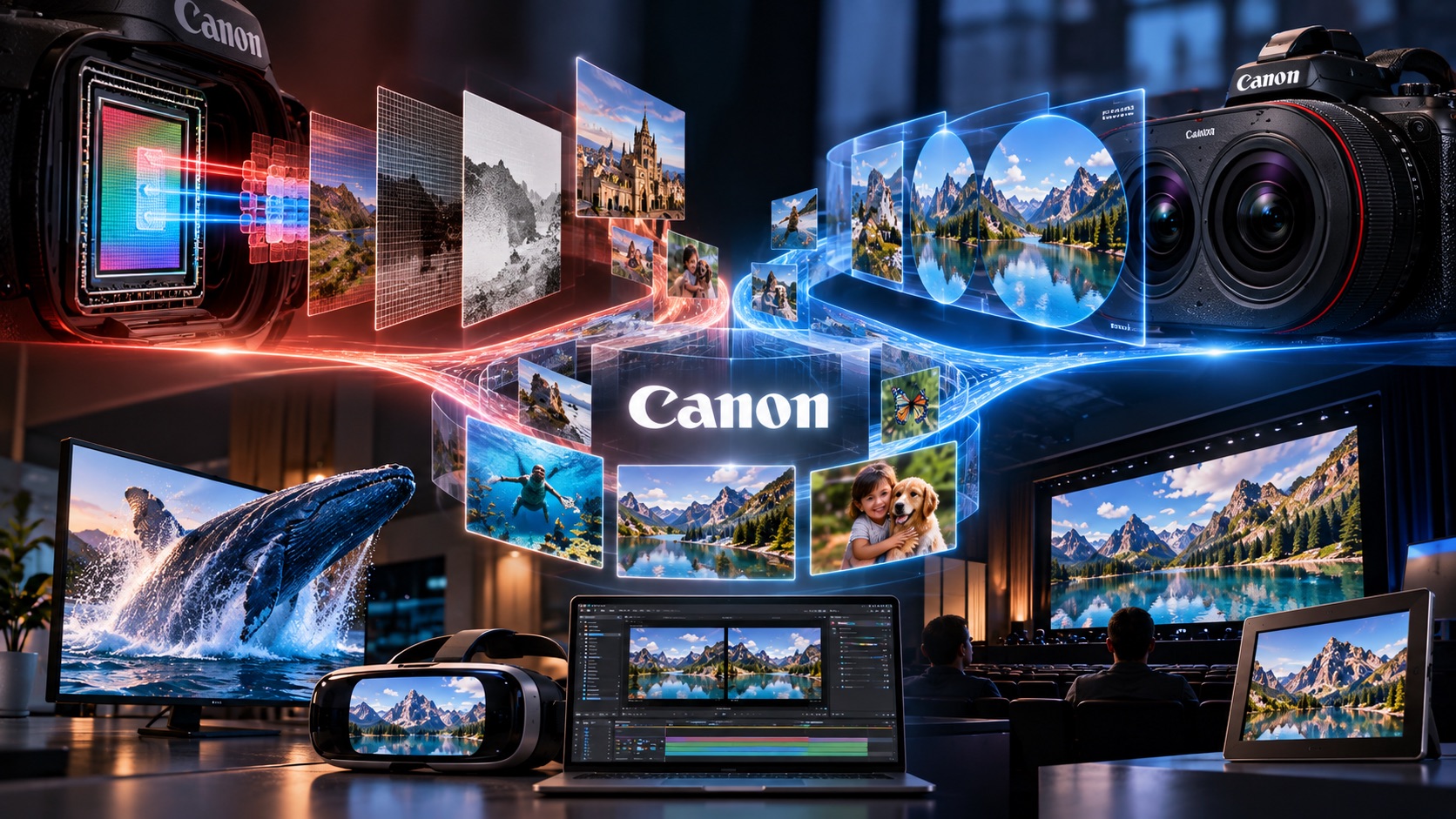
From Dual Pixel 3D and DUAL lenses to Spatial Video, VR180 and EOS VR: Canon is quietly building one of the most complete 3D imaging ecosystems.
For years, stereoscopic photographers have had to build their own ecosystems: Two cameras. Two lenses. Synchronization hardware. Custom rigs. Alignment software. Special workflows. And, frequently, a considerable amount of patience.
That’s one of the reasons Canon’s growing commitment to stereoscopic imaging deserves more attention than it has received.
At first, Canon’s unusual DUAL lenses could easily be seen as niche accessories primarily intended for VR180 creators. But look at what the company has assembled today and a much larger picture emerges.
Canon now has multiple stereoscopic lenses, an expanding range of compatible consumer and professional cameras, dedicated 3D processing software, support for VR180, conventional 3D presentation and Spatial formats, and direct collaboration with Apple on modern 3D distribution formats.
This isn’t a single experimental product anymore.
It’s becoming an ecosystem.
And Canon itself is increasingly talking about 3D as part of the future of imaging. In its 2026/2027 corporate overview, the company goes as far as stating that “3D imaging is shaping the future.”
Dual Pixel 3D: what if the 3D camera is already inside the camera?
The latest piece of Canon’s 3D strategy may be the most intriguing of all: Dual Pixel 3D.
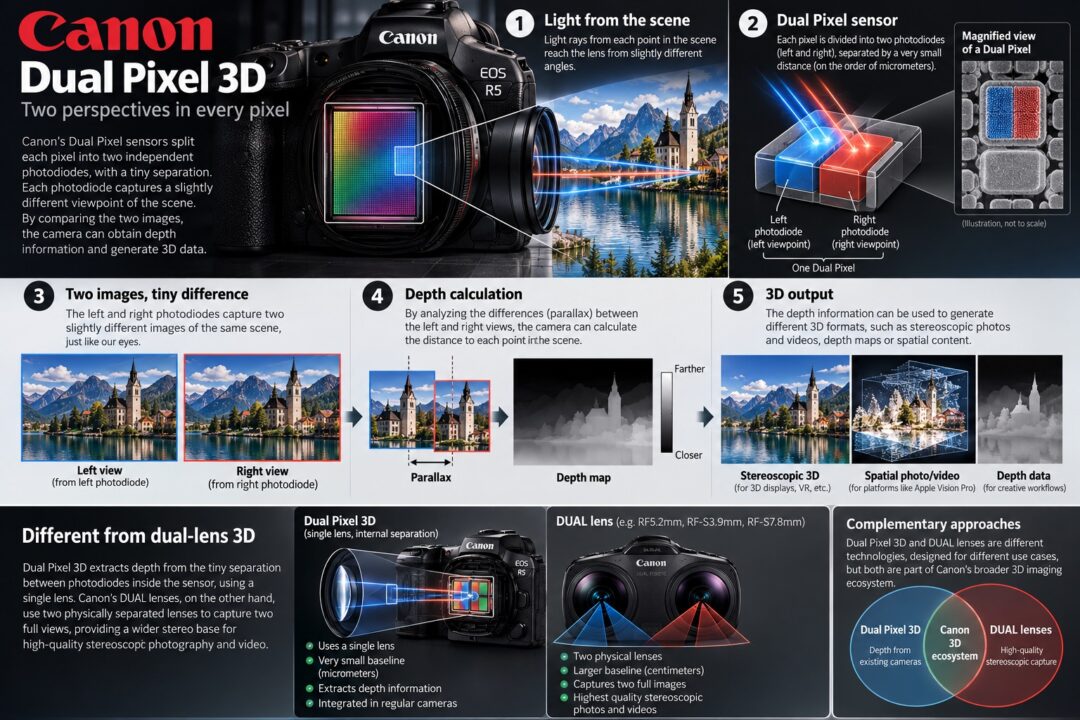
Canon’s Dual Pixel sensors already divide each pixel into two photodiodes, originally designed to provide phase-detection autofocus across the image sensor. But that tiny difference in viewpoint also contains parallax information — in other words, information about the distance and three-dimensional structure of the scene.
Canon is now developing technology that takes advantage of that information to generate 3D data from images captured with a conventional camera and lens.
And that makes Dual Pixel 3D fundamentally different from Canon’s DUAL FISHEYE and DUAL lenses. Those lenses capture two genuinely separated viewpoints through two optical systems, making them suitable for high-quality stereoscopic photography and video. Dual Pixel 3D instead attempts to extract depth information from the microscopic left/right separation already present inside a Dual Pixel sensor.
The stereo baseline is therefore dramatically smaller, so we shouldn’t expect it to replace a purpose-built stereoscopic lens for every application. But that may not be the point.
Its potential advantage is scale.
Canon has spent years putting Dual Pixel technology inside conventional cameras. If 3D information can increasingly be extracted from hardware that photographers already use, stereoscopic and spatial imaging no longer necessarily require a visibly unusual dual-lens camera.
And suddenly Canon’s recent activity starts looking much less like a collection of unrelated 3D experiments.
Dual Pixel 3D. DUAL lenses. EOS VR Utility. VR180. 3D Theater. Spatial Video and Spatial Photo. Volumetric Video. MREAL.
Canon isn’t developing one way of capturing 3D. It’s developing an ecosystem of different ways to capture, process and deliver three-dimensional information.
Canon has been quietly building this for years
The foundation arrived in 2021 with the RF5.2mm F2.8 L DUAL FISHEYE.
Instead of using two separate cameras, Canon placed two optical systems inside a single RF lens, projecting both perspectives onto the same camera sensor.
That seemingly simple idea eliminates several of the traditional complications of professional stereoscopic capture. There are no two cameras whose recording needs to be synchronized, no two sensors producing slightly different color or exposure, and no pair of independent video files that must later be matched.
Canon’s own engineers explained that these exact problems — synchronizing two cameras, matching their images and simplifying post-production — were fundamental motivations behind the development of the EOS VR System.
The original 5.2mm lens captures two 190° views with a 60mm interaxial distance and can produce stereoscopic 3D 180° VR at resolutions up to 8K when paired with suitable EOS cameras.
But Canon didn’t stop there.
From one exotic lens to a family of 3D optics
The RF-S3.9mm F3.5 STM DUAL FISHEYE brought the concept to APS-C cameras and reduced the field of view to 144°. It retained a 60mm distance between the left and right optical centers while adding STM autofocus for still photography. (Canon U.S.A.)
Then Canon took an even more interesting step with the RF-S7.8mm F4 STM DUAL.
This isn’t simply another ultra-wide VR180 lens.
Its two optical systems provide a much narrower field of view of around 60°, with a very small stereo base designed particularly for subjects at relatively short distances. Canon explicitly promotes output not only for 3D 180°, but also for 3D Theater and Spatial Video.
That distinction matters.
The EOS VR System is no longer exclusively about putting on a headset and looking around a 180° environment.
Canon is increasingly providing tools for creating stereoscopic images that can be consumed in different ways.
And that is exactly what 3D needs.
The camera is becoming part of the system too
Another sign that this is becoming an ecosystem is the growing list of compatible camera bodies.
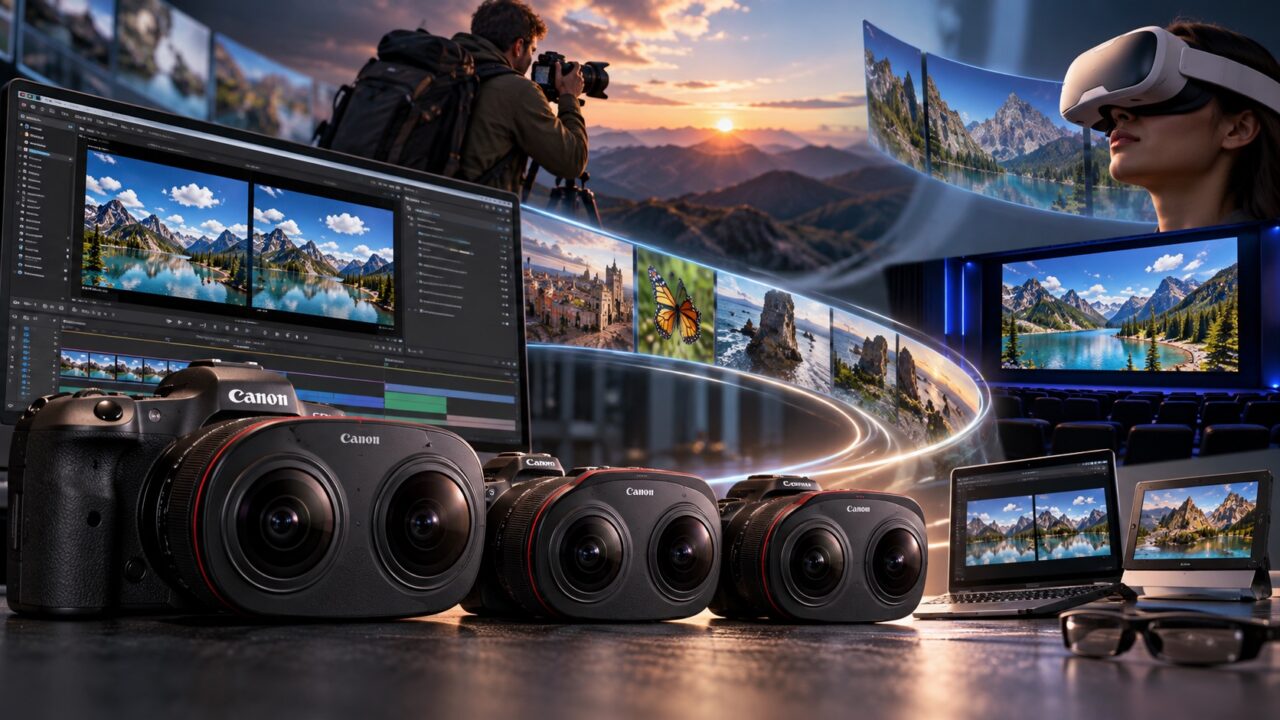
Canon currently presents the EOS VR System as a combination of DUAL lenses, compatible EOS R and Cinema EOS cameras, and EOS VR software.
The professional RF5.2mm lens can be used across cameras including the EOS R5, R5 Mark II, R5 C, R6 Mark II, C400 and C80, while the APS-C RF-S3.9mm and RF-S7.8mm lenses support cameras including the EOS R7 and the newer EOS R50 V. Canon has continued expanding compatibility through firmware and newer camera bodies rather than leaving the lenses tied permanently to one camera.
This is important because one of the historical weaknesses of stereoscopic photography has been hardware fragmentation.
A dedicated 3D camera is wonderful until its electronics become obsolete. Then you replace the entire device.
Canon’s approach is fundamentally different.
The stereoscopic optics are becoming part of an interchangeable-lens camera system.
Upgrade the camera and potentially keep the lens. Use the same camera for conventional photography and switch to a DUAL lens when you want to capture stereoscopic content.
3D becomes another capability of the camera rather than requiring an entirely separate photographic world.
And Canon is building the missing software layer
Hardware alone isn’t enough.
Anyone who has spent years working with stereoscopic photography knows that capturing two images is only the beginning.
They need to be interpreted, aligned, corrected, formatted and exported into something another device can actually display.
That’s where EOS VR Utility becomes arguably as important to Canon’s strategy as the lenses themselves.
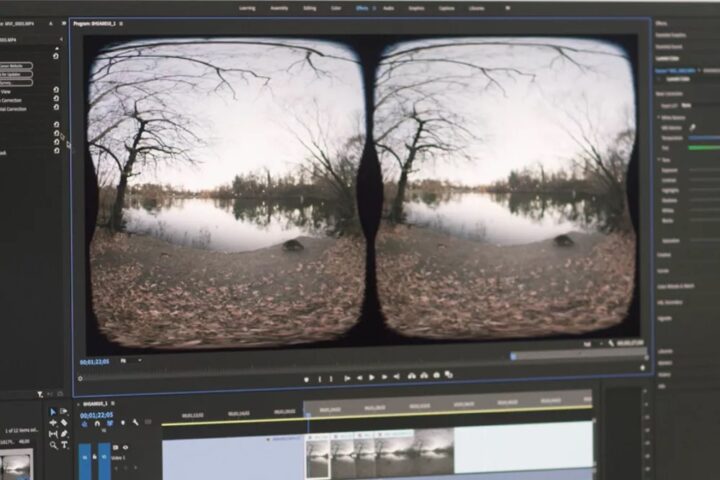
Canon’s current EOS VR Utility can perform parallax and horizontal corrections, image stabilization, lens corrections and conversion of the unusual raw dual-lens image into useful stereoscopic formats. Canon explicitly lists exports for 180° VR, 360° VR, 3D Theater and 3D Spatial, although 3D Spatial export is currently listed as Mac-only.
There is also an EOS VR Plug-in for Adobe Premiere Pro, allowing the conversion workflow to be integrated directly into a professional editing environment.
This is where the word ecosystem becomes particularly appropriate.
Canon isn’t asking another company to figure out what to do with the two images produced by its lenses.
It’s building the capture and processing pipeline itself.
Apple may have accelerated something much bigger
The arrival of Apple Vision Pro and Apple’s Spatial formats has given Canon another obvious destination for all of this content.
In 2025, Canon announced deeper collaboration with Apple. The RF5.2mm and RF-S3.9mm DUAL FISHEYE lenses gained a path towards Apple’s Projected Media Profile, while Canon also expanded the RF-S7.8mm workflow from Spatial Video to Spatial Photo through EOS VR Utility.
Canon explicitly described the objective as helping expand the 3D VR market.
That wording is important.
This isn’t merely Apple compatibility being added to an existing lens as a checkbox.
Canon sees interoperability with modern spatial platforms as a way of expanding the market for its 3D imaging system.
And we think this is precisely the right direction.
3D shouldn’t require one camera for VR, another camera for stereoscopic displays, another format for a headset and yet another workflow for photographs.
The same high-quality stereoscopic source should ideally be adaptable to different ways of viewing it.
The 3D community has noticed
This development hasn’t gone unnoticed among experienced stereoscopic photographers.
Discussions within the long-running Photo-3D community on Groups.io have followed Canon’s DUAL lenses closely.
When the RF-S3.9mm was announced, community discussion immediately examined details that conventional camera coverage often overlooks: stereo base, field of view, projected pixel density and how its narrower 144° image might actually provide advantages in perceived sharpness compared with stretching a wider fisheye image across the same viewing area.
The reaction to the RF-S7.8mm has been particularly interesting.
One experienced user who tested it on an EOS R7 praised its sharpness, autofocus and optical quality compared with older compact stereoscopic solutions, describing Canon as having effectively become a leader in 3D lenses. (Canon Community)
That’s significant because this isn’t enthusiasm coming from people discovering stereoscopy for the first time.
These communities contain photographers who have spent decades using dual-camera rigs, stereo adapters, specialized lenses and dedicated 3D cameras.
Canon is entering a field whose enthusiasts know very well how difficult high-quality stereoscopic capture can be.
Please don’t lock this ecosystem to headsets
There’s another opportunity here that we hope Canon doesn’t overlook.
Much of Canon’s marketing understandably revolves around VR headsets and Apple Vision Pro.
But stereoscopic content no longer belongs exclusively inside headsets.
We are seeing a new generation of glasses-free 3D monitors, laptops, tablets and other displays. And traditional stereoscopic projection and displays remain perfectly valid ways to enjoy 3D content.
Interestingly, Canon itself already acknowledges this.
Its documentation for the RF-S7.8mm explicitly lists naked-eye 3D displays among the recommended viewing methods, alongside VR goggles and other devices.
That’s a small line in a technical document, but philosophically it’s important.
Canon isn’t merely building a Vision Pro camera system.
It has the ingredients for something much broader:
A professional stereoscopic capture ecosystem.
3D Theater may be more important than it sounds
This is why we’re particularly interested in Canon’s use of the term 3D Theater.
VR180 is excellent for immersion, but it isn’t appropriate for every image.
Sometimes photographers simply want what stereoscopic photography has provided for more than a century: a conventional framed composition with a left-eye and right-eye view producing genuine depth.
No looking behind you. No virtual environment.
Just photography — in 3D.
By allowing EOS VR Utility to extract and export conventional stereoscopic imagery from its DUAL lenses, Canon can connect its modern optical system not only with VR but with the much broader history and future of stereoscopic displays.
And that could become increasingly valuable as more glasses-free screens appear.
Canon now has something few competitors can offer
There are plenty of ways to record 3D.
Smartphones can capture spatial video. Dedicated VR cameras can capture immersive scenes. Enthusiasts can synchronize two cameras. Specialist manufacturers can build extremely sophisticated professional rigs.
But Canon is approaching the problem differently.
It can offer:
A conventional interchangeable-lens camera, professional photographic image quality, purpose-built stereoscopic optics, single-sensor synchronized capture, autofocus on newer lenses, dedicated processing software, professional editing integration and output for multiple modern 3D formats.
And importantly, the photographer doesn’t have to abandon the conventional camera ecosystem to obtain it.
That’s potentially enormous.
A Canon owner doesn’t necessarily need to decide “I’m buying a 3D camera.”
They can buy a Canon camera.
And attach a 3D lens.

That subtle difference could ultimately be more important for stereoscopic photography than another standalone 3D camera ever would be.
Canon itself now says 3D imaging is shaping the future
Perhaps the strongest indication that we shouldn’t dismiss all this as a niche experiment comes from Canon itself.
In the company’s Canon Story 2026/2027, Canon dedicates part of its imaging strategy to 3D and explicitly states:
“3D imaging is shaping the future.”
The company doesn’t mention only EOS VR. It places it alongside technologies such as Dual Pixel 3D, volumetric video and MREAL mixed reality as examples of Canon expanding the possibilities of three-dimensional imaging.
Canon has also told investors that it intends to strengthen collaboration with companies responsible for VR viewing equipment and content production, with the objective of expanding adoption in both consumer and business markets.
And when Canon executives were directly asked whether there really is a market for stereo/3D lenses, the response was unusually clear.
Canon said it remains committed to the category despite the market still being at an early stage, believes the 3D space will grow significantly, and wants to be at the forefront of that development.
For 3D enthusiasts, those may be some of the most encouraging words we’ve heard from a major camera manufacturer in years.
This is what normalization looks like
There’s an interesting parallel with what we’ve recently seen elsewhere in the 3D industry.
The most important progress may not come from creating another isolated product proudly labelled “3D CAMERA”.
It may come when 3D becomes another capability inside products people already understand.
A normal gaming monitor that also has 3D.
A normal laptop that also has 3D.
And now, potentially, a normal professional camera system that can become a high-quality stereoscopic camera simply by changing the lens.
That’s how technologies become normal.
Canon already has the optics.
It has the cameras.
It has the software.
It has professional editing integration.
It supports VR180, conventional 3D presentation and modern Spatial formats.
And it is actively collaborating with one of the companies pushing spatial media towards mainstream consumers.
The pieces are already there.
Now Canon needs to continue connecting them — particularly by making EOS VR Utility as flexible and powerful as the hardware deserves, expanding compatibility, embracing high-quality standard stereoscopic outputs and ensuring that content created with these cameras isn’t unnecessarily tied to one headset or one viewing platform.
Because Canon may have quietly built something much more important than a collection of unusual lenses.
It may be building the first genuinely expandable 3D imaging ecosystem from a major camera manufacturer.