
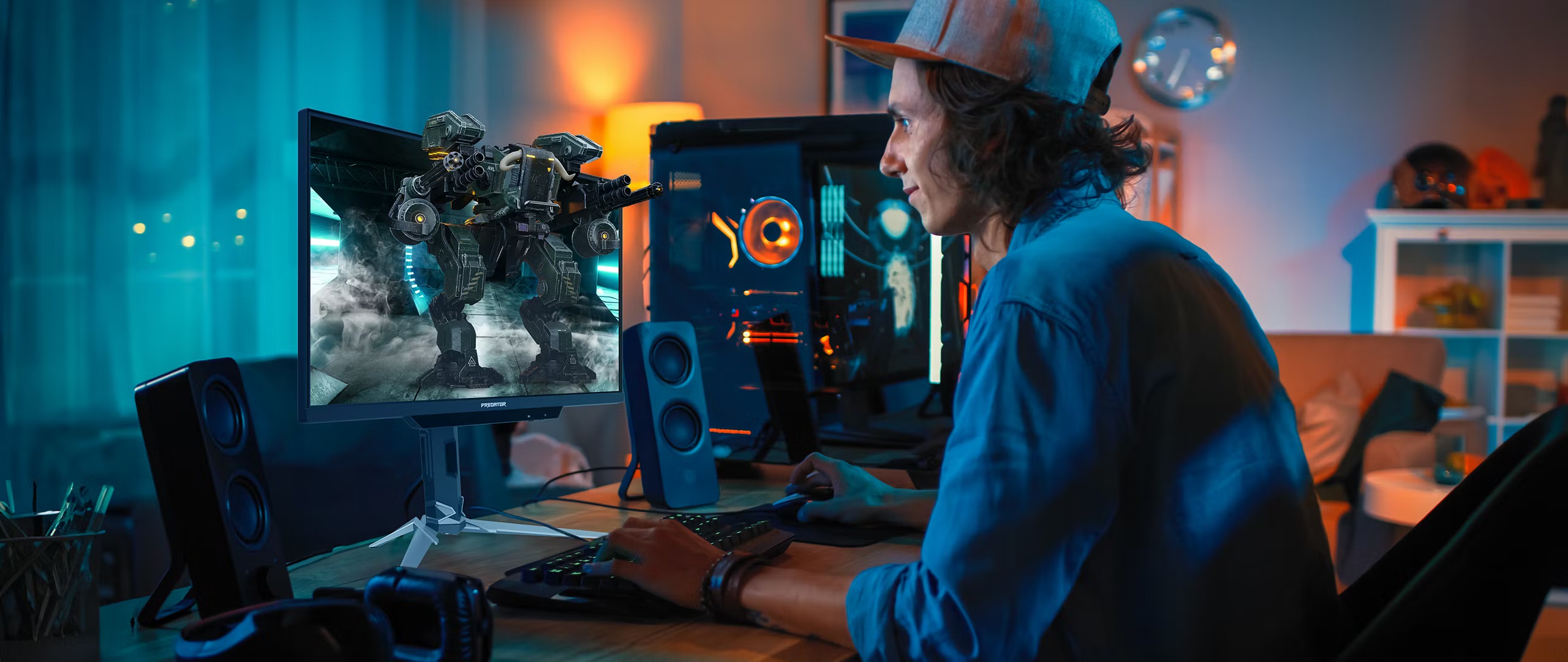
Yesterday, while investigating the newly announced Acer Aspire G 3D 16, we discovered something unexpected.
The Aspire wasn’t Acer’s first recent 3D product to move away from the familiar SpatialLabs hardware branding. A few months earlier, Acer had quietly announced another glasses-free 3D display: the Predator XB273K 3D.
And the more we investigated it, the more interesting the story became.
Because this isn’t simply another SpatialLabs monitor under a different name.
The Predator XB273K 3D introduces a different SpatialLabs software platform, a different gaming catalogue and apparently a separate hardware ecosystem from the one used by existing displays such as the SpatialLabs View 27.
We even tried installing the new software on our own SpatialLabs monitor.
It doesn’t recognize it.
So what exactly is Acer building?
A 27-inch 4K Predator with glasses-free 3D
Acer announced the Predator XB273K 3D on May 29, 2026, as part of its new generation of Predator gaming monitors. Unlike the Predator SpatialLabs View 27, even the SpatialLabs name has disappeared from the product name.
The specifications are nevertheless those of a serious high-end gaming monitor: a 27-inch IPS panel with 3840×2160 resolution at up to 180 Hz, 400 nits brightness, 95% DCI-P3 coverage, 0.5 ms minimum GTG response time, HDMI 2.1 and DisplayPort 1.4. It supports both AMD FreeSync Premium and NVIDIA G-SYNC Compatible.
And, of course, it has glasses-free stereoscopic 3D with eye-tracking.
Acer says the monitor incorporates a local AI model capable of using the connected computer’s graphics processing power to transform conventional 2d content into 3D. More interestingly, however, Acer introduced an entirely new application alongside the monitor: SpatialLabs 3D Hub.
That last detail turns out to be much more important than it initially appears.
The XB273K 3D is scheduled for Q4 2026 in North America and EMEA, starting at $1,299.99 / €1,499, while Acer originally scheduled its Chinese release for Q3.
This isn’t the SpatialLabs software we already know
Existing SpatialLabs displays use the SpatialLabs Experience Center, which provides access to applications such as TrueGame and the rest of Acer’s established 3D ecosystem.
The XB273K 3D instead debuts SpatialLabs 3D Hub.

At first, it would be easy to assume that 3D Hub is simply a new interface or the next version of Experience Center.
Our investigation suggests otherwise.
An early XB273K 3D owner encountered exactly this problem. He had found the extensive TrueGame catalogue and naturally assumed that Acer’s new 3D gaming monitor would support it. Only after trying to install SpatialLabs Experience Center did he discover that the software wouldn’t even recognize his XB273K 3D.
He simply wasn’t aware that the game catalogue he was looking at belongs to Acer’s existing SpatialLabs products, while his new monitor requires the separate SpatialLabs 3D Hub instead. With both platforms carrying the SpatialLabs name but using different software, different hardware compatibility and different game catalogues, it’s easy to see how users can get confused.
That already suggested that these were two separate ecosystems.
We installed SpatialLabs 3D Hub on our own Acer SpatialLabs View 27.
And 3D Hub doesn’t recognize our monitor either.
This is particularly interesting because our View 27 works, of course, with SpatialLabs Experience Center and TrueGame. We therefore have essentially the inverse situation:
SpatialLabs View 27 (and other SpatialLabs & ConceptD devices) → Experience Center / TrueGame
Predator XB273K 3D (and Acer Aspire 3D) → SpatialLabs 3D Hub
At least with the hardware tested so far, these aren’t simply two applications that can be freely interchanged between Acer 3D displays.

Two SpatialLabs gaming catalogues
And this separation extends beyond the software itself.
TrueGame has spent years accumulating an extensive catalogue of supported games. The current library has reached — with September’s new titles still to come — 253 titles, with a large proportion offering the much more sophisticated 3D Ultra mode.
SpatialLabs 3D Hub, however, introduces another gaming system called 3D Spatial Gateway.
And this is already creating some confusion among users.
An early XB273K 3D owner naturally expected to find the extensive TrueGame library available on Acer’s new 3D gaming monitor. Instead, the software provided with the monitor presented a much smaller selection through 3D Spatial Gateway.
That’s an understandable assumption to make. Both products are Acer 3D gaming displays. Both ecosystems carry the SpatialLabs name. Yet buying one doesn’t currently appear to provide access to the gaming catalogue of the other.
For a potential buyer, Acer needs to make this distinction much clearer.
“Converted” and “unconverted” games?
There’s another intriguing clue inside 3D Spatial Gateway itself.
One of Acer’s screenshots divides the game library into categories labelled:
“Converted 3D Games” and “Unconverted 3D Games.”

We don’t yet know exactly what Acer means by this terminology.
It could indicate some form of game-specific conversion profile or compatibility patch. It could potentially even provide a way for developers or the community to expand compatibility in the future. But Acer hasn’t provided enough technical information for us to establish who performs these conversions, how they work, or whether users will eventually be able to create them themselves.
If it does work through conversion profiles or fixes, however, we find that approach less attractive than TrueGame’s 3D Ultra catalogue.
Community fixes and conversion profiles can sometimes achieve excellent results, but their quality tends to vary considerably between games. They rarely provide the consistently polished results possible when a stereoscopic solution has been properly optimized for an individual title.
And that’s precisely where TrueGame has become so good.
3D Ultra is one of Acer’s greatest 3D assets — a treasure it shouldn’t leave behind
TrueGame’s 253 games represent much more than a compatibility number.
They represent years of accumulated work, optimization and experience that Acer has already transformed into a considerable competitive advantage.
We’ve extensively tested the platform on our SpatialLabs View 27, and many 3D Ultra profiles produce some of the most impressive stereoscopic gaming we have experienced on any platform, including NVIDIA 3D Vision — for years the virtually unbeatable benchmark for extreme stereoscopic depth and the sheer number of games capable of delivering superb 3D.
With the best profiles, there’s no searching forums for fixes, experimenting with obscure parameters or accepting rendering defects. You launch the supported game and the 3D can simply be spectacular.
That’s why seeing Acer start another gaming catalogue almost from scratch inevitably makes us a little nervous.
Please expand it, don’t restart it
If 3D Hub were eventually intended to replace the existing SpatialLabs platform rather than complement it, Acer would effectively be starting again from a much earlier point — while leaving behind one of the strongest assets it has built for stereoscopic gaming.
We would hate to see years of excellent 3D work become a legacy ecosystem just when it has become one of Acer’s greatest advantages in 3D gaming.
Fortunately, existing SpatialLabs owners shouldn’t panic.
There is currently no evidence that Acer is abandoning TrueGame.
In fact, the evidence we have today points in precisely the opposite direction.
For years, Acer has consistently added five new TrueGame titles every month, with the new profiles reliably arriving at the end of each month without breaking that remarkably consistent release schedule.
So TrueGame is very much alive today.
The question isn’t what Acer is doing with TrueGame now, but what its long-term plans are.
We hope 3D Hub is intended to expand Acer’s 3D ecosystem rather than restart it.
3D Hub may eventually provide broader hardware support and greater flexibility. TrueGame already has the catalogue, maturity and exceptional 3D quality.
Combining those strengths would be far more exciting than having to choose between them.
And 3D Hub may be much bigger than this monitor
There’s another small detail in Acer’s 3D Hub interface that makes the new platform particularly interesting.
The device selector doesn’t show only a monitor.

It depicts three different types of hardware: a monitor, glasses and a laptop.
We now know about two of them. The Predator XB273K 3D is the monitor, while the recently discovered Aspire G 3D 16 provides an obvious candidate for the laptop.
And then there are those glasses.
Acer also announced the AR Vision GR0 on May 29 — interestingly, the very same day as the XB273K 3D. They contain dual micro-OLED displays and explicitly support stereoscopic 3D content, with Acer specifying a combined 3840×1080 resolution in 3D.
The presence of a glasses icon in 3D Hub therefore immediately caught our attention.
We don’t yet have enough evidence to state that the icon specifically represents the GR0 or exactly how those glasses will interact with SpatialLabs 3D Hub, so we’ll leave that question open for now.
When the AR Vision GR0 reaches the market, we’ll dedicate a separate article to them with all the details.
What matters here is the larger implication: 3D Hub appears to have been designed with multiple categories of 3D hardware in mind.
And suddenly the word “Hub” makes considerably more sense.
Is SpatialLabs becoming the technology rather than the product?
There’s an interesting naming pattern emerging.
Acer previously gave us the Predator SpatialLabs View 27.
Now we have the Predator XB273K 3D.
And shortly afterwards came the Aspire G 3D 16.
The SpatialLabs name has disappeared from the names of both new pieces of hardware — yet it remains very much alive inside SpatialLabs 3D Hub.
Perhaps this is more than a branding decision.
As we discussed when discovering the Aspire G 3D 16, Acer may be reaching a point where 3D no longer needs to define an entire product family. A Predator monitor can simply have 3D. An Aspire laptop can simply have 3D. And potentially very different kinds of devices can connect to the same underlying 3D platform.
That would be an important step towards normalizing stereoscopic 3D.
But Acer now has another challenge: making sure that this expansion doesn’t fragment what it has already achieved.
Today we apparently have two SpatialLabs software ecosystems, two gaming catalogues and different compatible hardware, with product names that don’t necessarily make those distinctions obvious.
Perhaps Acer intends to eventually bring them together. Perhaps they are designed to coexist for different kinds of hardware. Or perhaps 3D Hub represents the beginning of a longer transition.
We simply don’t know yet.
What we do know is that Acer has spent years building one of the best stereoscopic gaming ecosystems we have ever used.
3D Hub should expand that achievement, not restart it.